

Before reading further in this RankTracker review, let’s clear up some misconceptions…
This is not a random article from a pushy affiliate marketer.
The information you’re about to read is based on practical experience with Rank Tracker.
If you run a local or international SEO, you need a tool to find the right keywords and track positions from any database. Rank Tracker allows you to analyze, track rankings, and perform competitive intelligence.
That said, let’s dive in.
Rank Tracker
Discover our in-depth Rank Tracker review that takes you through every facet of this powerful SEO tool. In our article, we explore Rank Tracker’s core features, including its keyword monitoring, competitor analysis, and reporting capabilities, while examining its user interface, data accuracy, support, and pricing plans.
Price: 179
Price Currency: USD
Operating System: Windows, macOS, Linux
Application Category: BusinessApplication
4.08
If you prefer a visual tutorial, here is a walkthrough video.
What is Rank Tracker?
Rank Tracker is a powerful tool from SEO PowerSuite designed to help you track and improve your website’s search engine rankings.
It is part of the broader SEO PowerSuite toolkit and focuses specifically on rank tracking, keyword research, and competition analysis. Here’s a detailed breakdown of what Rank Tracker offers:
Key Features of Rank Tracker
To learn more about all the features, helpful information, and lifetime deal availability, continue reading our RankTracker review below.
Keyword Research and Analysis
Rank Tracking
Competitor Analysis
SERP Features and Metrics
Customizable Reports
Integration and Workflow
Cross-Platform Functionality
Free and Paid Versions
Why Should I Use RankTracker?
If you’re serious about improving your online visibility, the Rank Tracker from SEO PowerSuite is a game-changer.
It is a comprehensive solution that empowers you to make smarter marketing decisions and stay ahead of the competition.
Comprehensive Insights
Rank Tracker offers in-depth data on your search results performance, showing exactly how your target terms perform across search engines like Google, Yahoo, and Bing.
It doesn’t stop there—it also dives into competitor strategies, helping you identify what’s working for others in your niche. This gives you a clear path to outrank them and discover untapped content opportunities.
Ease of Use
Whether you’re a beginner or an SEO pro, Rank Tracker’s intuitive interface makes it easy to use.
You can generate straightforward reports that provide actionable insights without a steep learning curve. It’s built to simplify SEO for everyone, making it easier to implement effective strategies, regardless of experience level.
Flexibility
One of its standout features is its support for various search engines and regional targeting.
This makes it perfect for local, national, or global brands. It adapts to your needs, whether you’re focusing on a small geographic area or a worldwide market.
Cost-Effectiveness
Compared to other tools, Rank Tracker offers incredible value. You get advanced features without breaking the bank, making it a smart investment for businesses of all sizes.
It’s proof that powerful SEO tools don’t have to come with a hefty price tag.
Rank Tracker allows you to monitor keyword positions, analyze trends, discover easy-to-rank terms, and refine your strategy based on real data. It’s the ultimate tool for ensuring your efforts drive results, helping you grow your business faster and smarter.
Review of Rank Tracker
Now that we’ve covered the basics, let’s review all the tool’s features.
Keywords Tracking
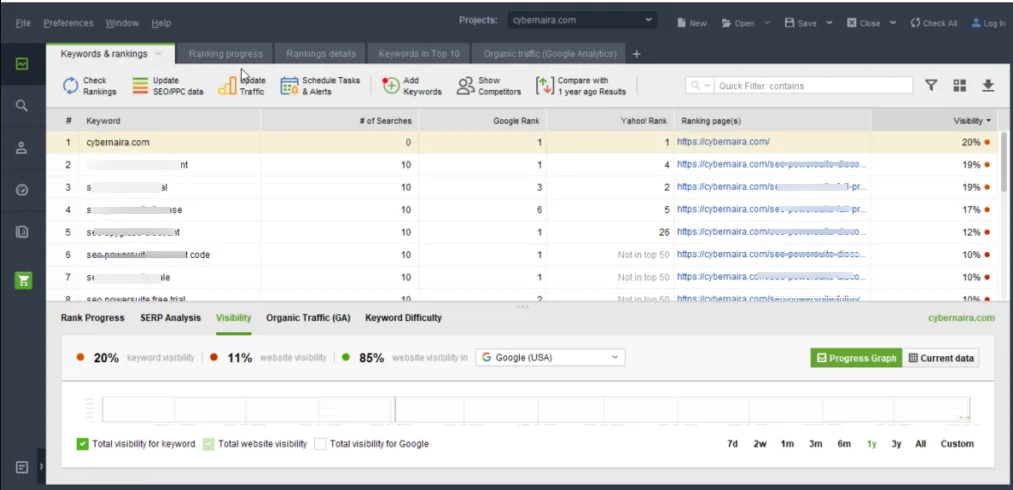
First, you can track rankings from over 597 search engines with several filtering options.
The ability to customize the working environment makes it a powerful tool. You can customize the work area to fit your optimization processes.
For instance, you can customize the work area only to display position performance from specific sources.
The purpose is to filter reports, such as data from specific search engines, to fit your preferences. You can even customize the display column for:
The settings panel offers many filtering options, including tags, notes, Google rank, landing page, clicks, and sessions.
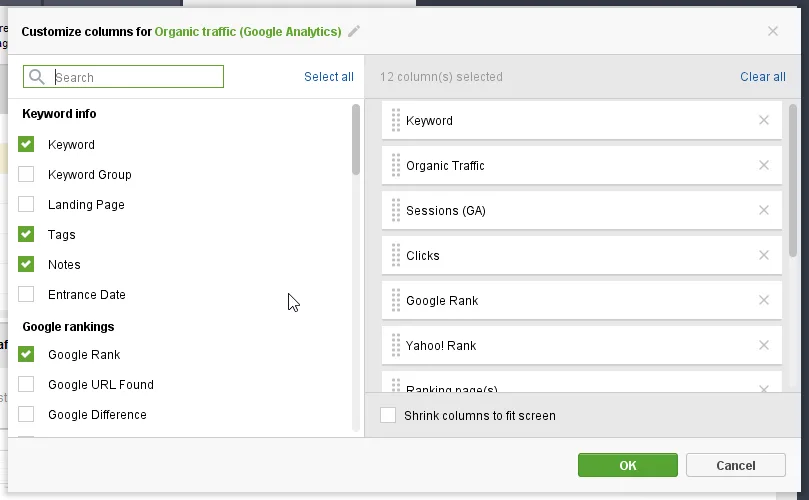
You can customize each tab to fit your site’s needs. There are endless options.
Keyword Rank Historical Data
Historical data is available if you’re using the Enterprise edition.
This feature allows you to see where you rank over time and compare yourself to your competition, which is an asset.
Highlighting any query in the spreadsheet provides additional performance information, including visibility and position within SERP features. This information is presented at the bottom of the page.
This extra data can be valuable for tracking your optimization and marketing efforts for specific content.
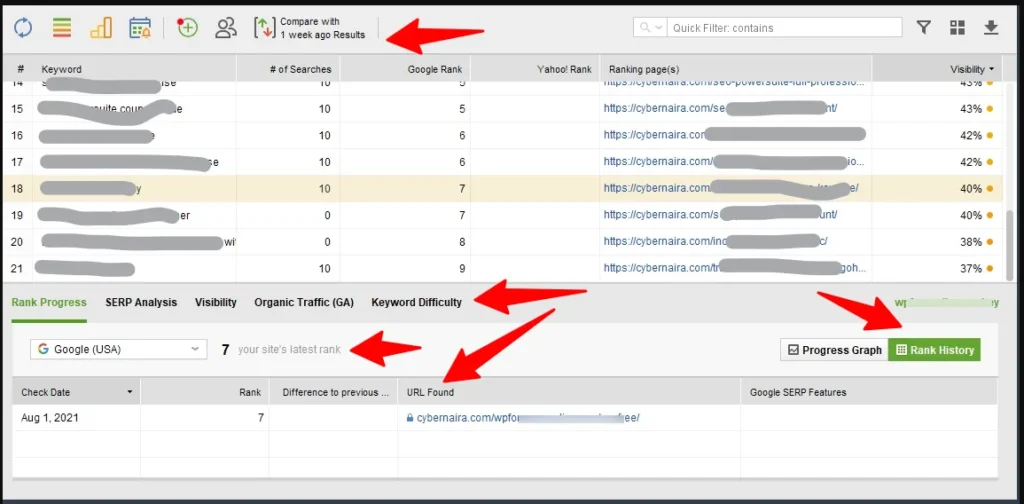
As you can see in the screenshot above, you can analyze other metrics from this feature set. The SERP checker is a feature you should consider.
These extra features analyze the competitor’s website and its current position in SERP.
It shows the first 30 competitors’ website rankings for the same queries, along with their current SERP positions.
The Visibility tab shows how progressive the target phrases have become over time in the selected search engine. It also shows you the current visibility score against the previous date range.
The difficulty tab shows how difficult it is to rank for that phrase. This score is calculated using various ranking metrics from the Google top 10.
It also reveals the top ten competitors for a given query, in-link rank, sites linking to the targeted page, and linking domains.
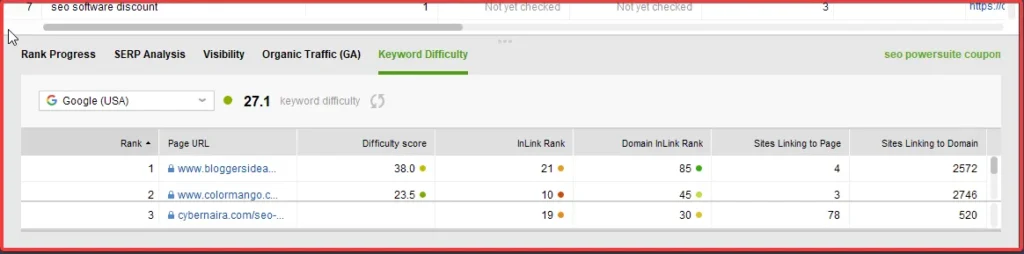
You can use this data to evaluate your chances of increased SERP visibility.
Keyword Map
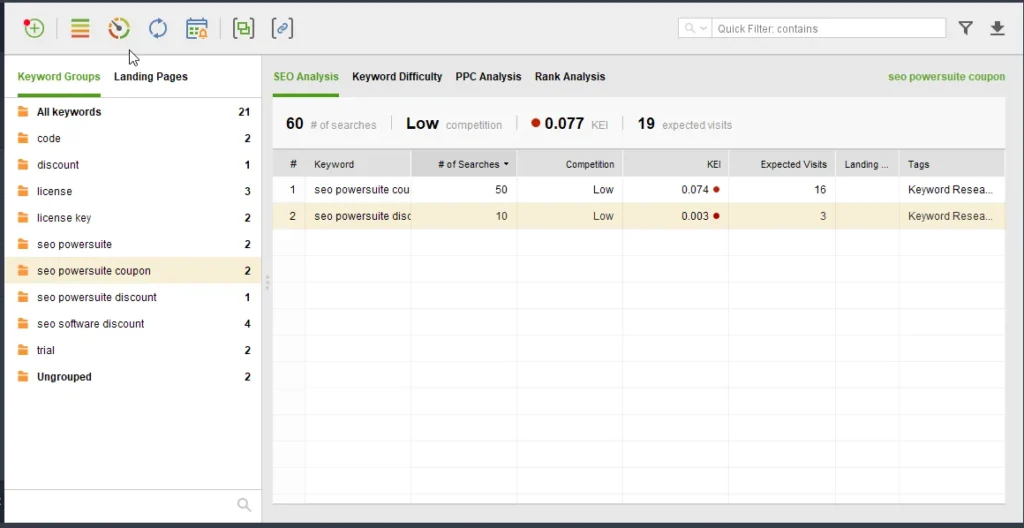
The keyword map tool helps organize related terms. You can further refine the reports by using tags for better sorting.
This allows you to be more efficient at tracking what works, what needs improvement, and what doesn’t.
Keyword Research
This section of the tool is more extensive than that of many keyword tools I have used. It covers more methods for identifying profitable keywords that users use and pulls data from many sources.
Let’s review each method one after the other:
Ranking Keywords
This method allows you to track a website’s Google rankings. It shows the top one hundred key terms for that domain.
Keyword Gap
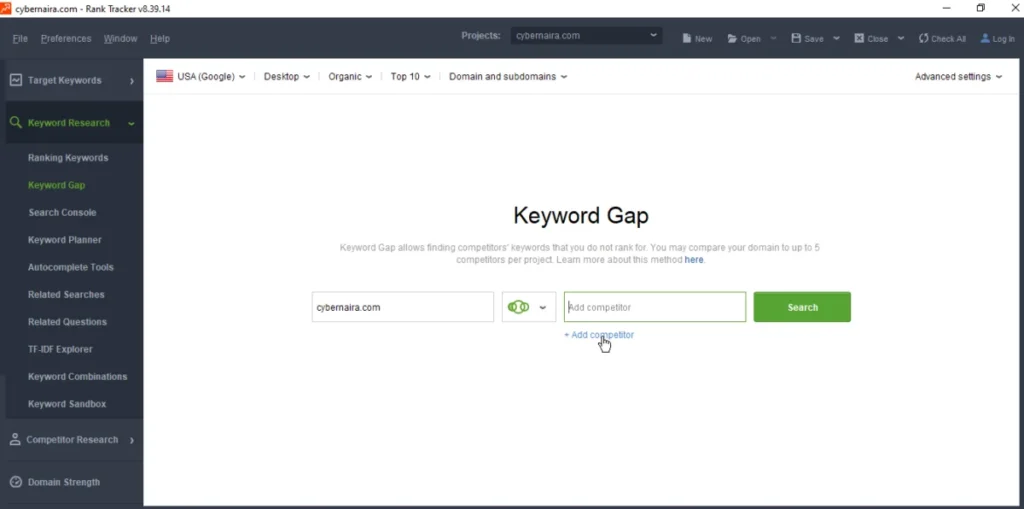
This method lets you find terms your competitors already rank for but not you. You can compare up to 5 competitors’ domains in the professional edition.
This feature is handy for finding valuable queries you can easily rank based on what’s already working for other businesses in your industry.
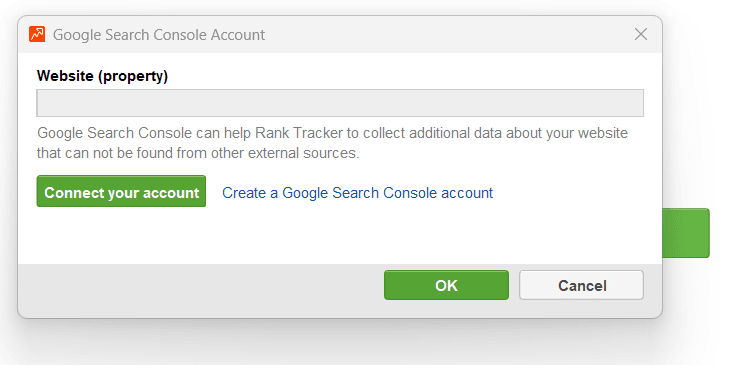
Search Console
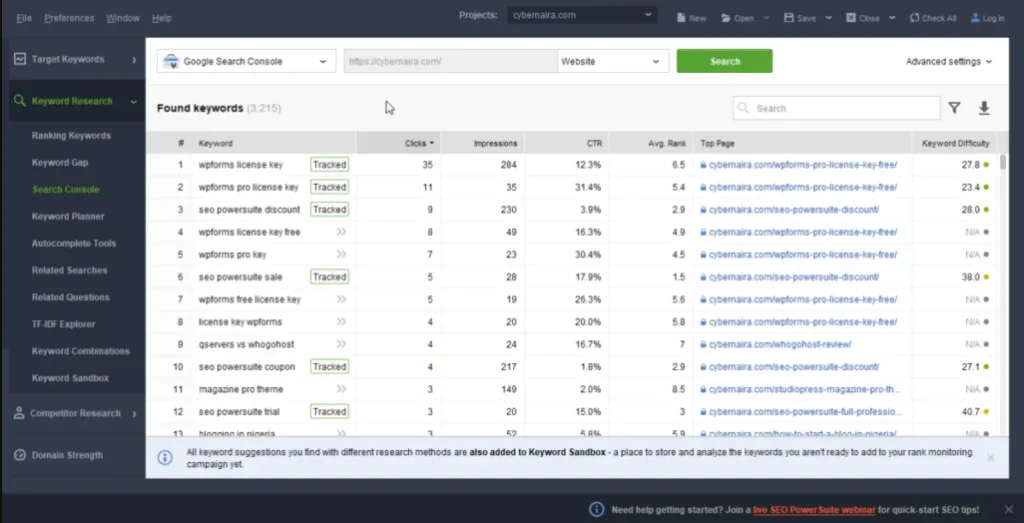
This is where you import Google Search Console data into the tool.
This feature is necessary to track the key terms that drive traffic from Google’s organic search results to your website. Here, you can see the number of clicks, impressions, click-through rate, average position, competitiveness, and target pages.
Keyword Planner
You get more data than with the native Google Keyword Planner. You’ll get keyword difficulty data, expected visits, monthly search volumes, and competition level.
The expected visit is my favorite here.
You’ll see the estimated monthly organic traffic if your target page ranks #1 on Google.
This is a handy feature for determining whether any content will succeed before writing it. So that you don’t waste time and resources on topics or content that won’t help growth.
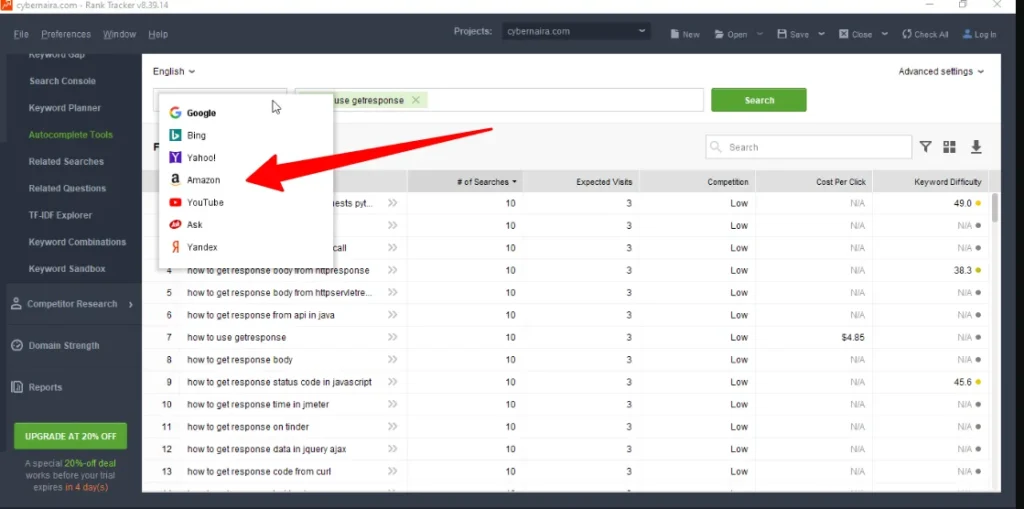
Autocomplete Tools
This pulls data from Google autocomplete features and other search engines, like:
This will allow you to do an in-depth analysis without leaving the tool interface. It is a handy feature for discovering long-tail queries.
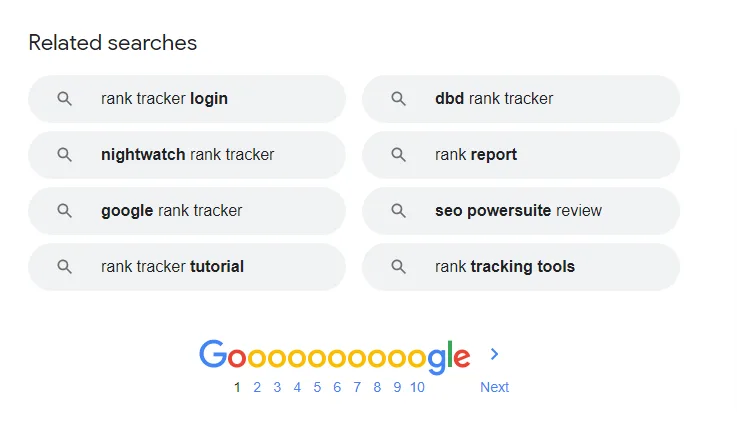
Related Searches
This feature lets you discover related terms based on the focus word.
Also, you get other relevant search queries based on your primary keyword. So, you don’t have to look it up on Google.
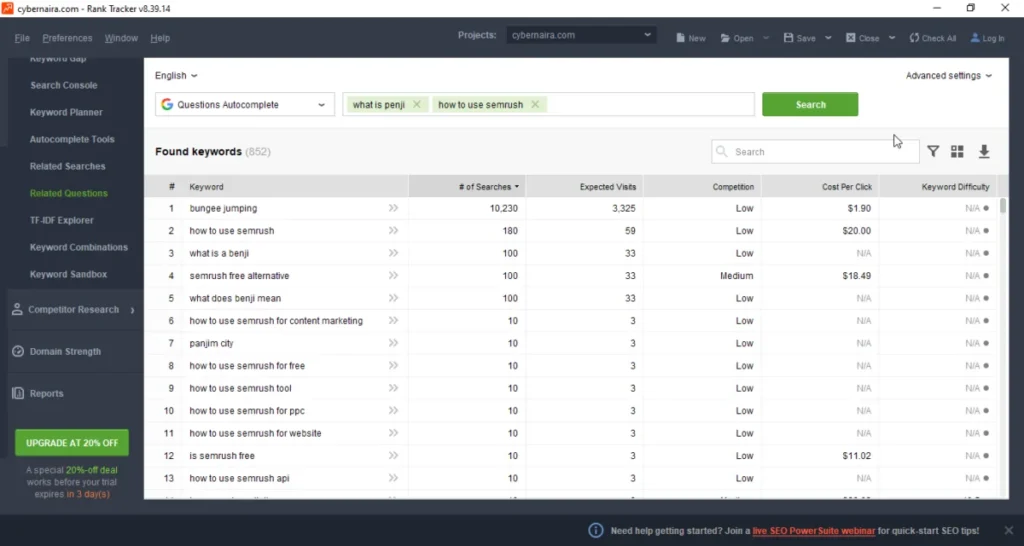
Related Questions
The related question feature uses a combination of questions to generate ideas for your primary topic.
This feature uses Google’s Question Autocomplete to generate related questions for the main topic.
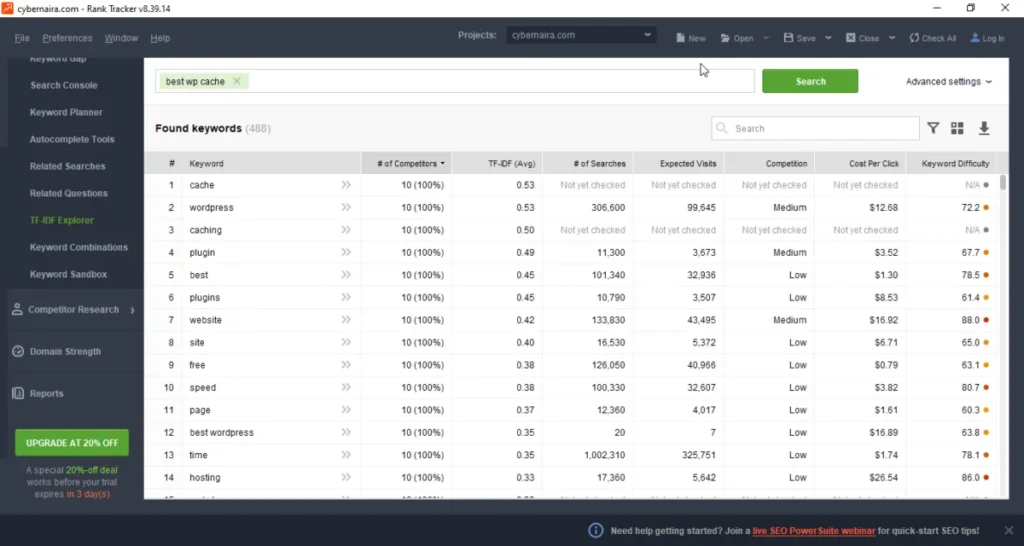
TF-IDF Explorer
This is a great feature for exploring competitor topics.
The TF-IDF explorer feature lets you run an in-depth analysis of competitor queries. You’ll discover phrases your competitors are already ranking for, but you’re not.
The page contains several useful data points for your marketing campaign. You can use this information to audit and target easy-to-rank keywords based on your content topics, industry, and domain authority.
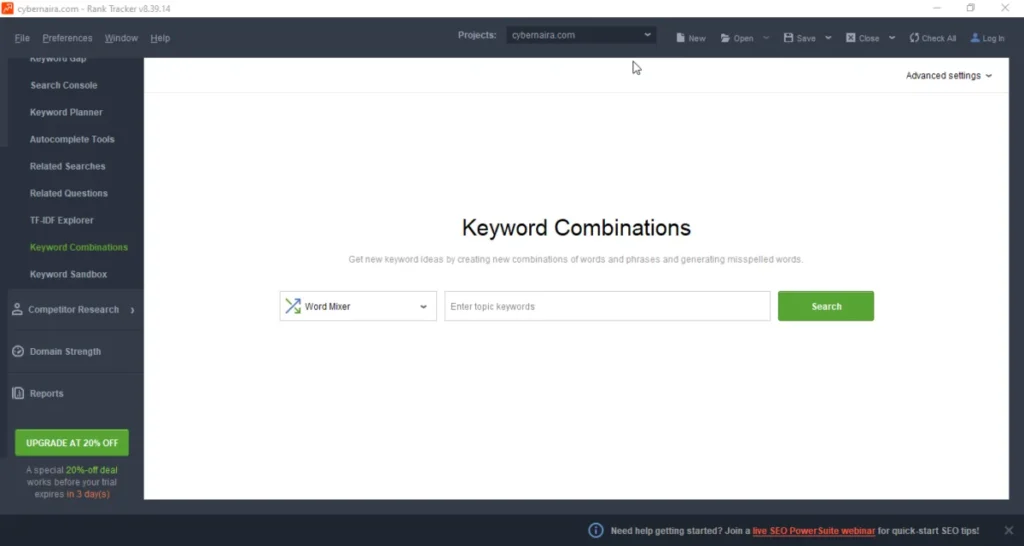
Keyword Combination
The keyword combination tool lets you analyze trends by combining key terms and misspelled words to generate new ideas.
This feature helps discover untapped topics, markets, industries, and content ideas.
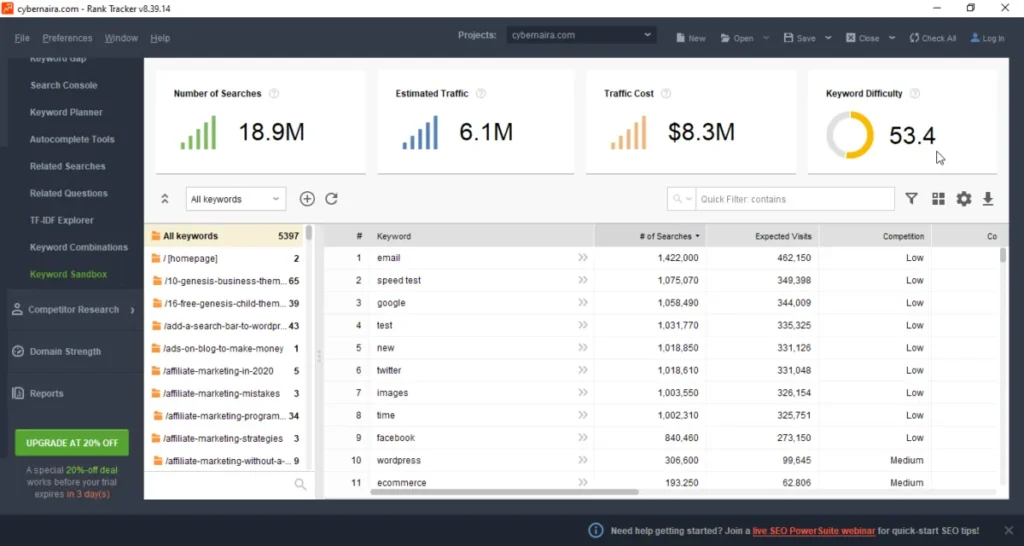
Keyword Sandbox
All your analyzed keywords are stored in the sandbox for further analysis. It has everything in the user interface, and keywords are grouped on their corresponding pages.
Competitors Research
This is a powerful way to spy on and monitor competitors. It’s built-in tool lets you dive deep into their SERP visibility, uncovering competitors’ top 100 ranking terms on Google.
Want to see how they fare on mobile or desktop? No problem. You can switch it up with just a click.
You have options: analyze a specific page or the entire domain. It’s all about giving you the data you need.
Rank Tracker offers three unique ways to explore your competitors’ search result visibility. Let’s break down each method…
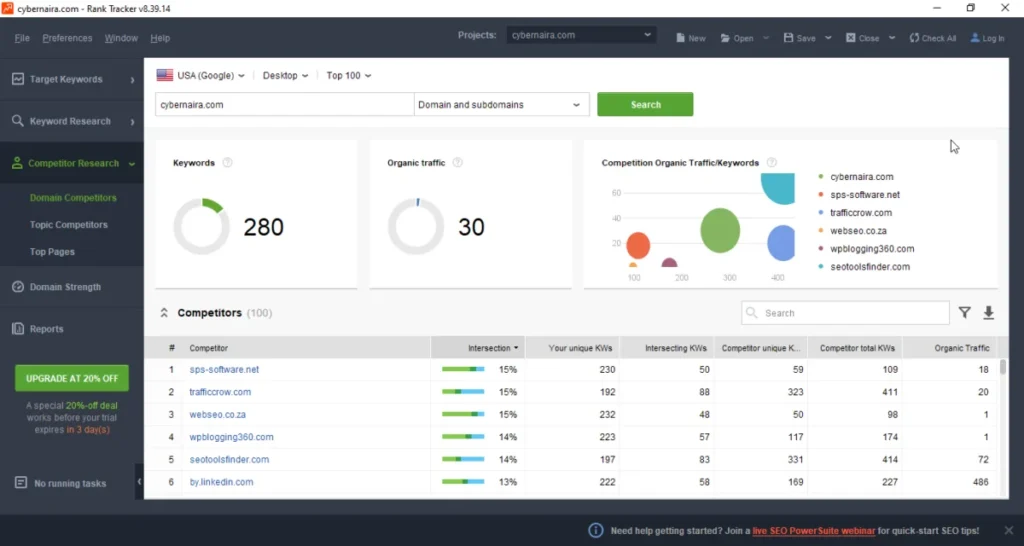
Domain Competitors
The domain competitors feature allows you to investigate competitor ranking terms, root domains, or exact page URLs. Honestly, this is my favorite tool, and I would love for you to explore it after reading through this RankTracker review.
It is a good, versatile SERP-checker and audit tool for competitive analysis.
Enter your site URL to uncover niche competitors. You can find competitors targeting your keywords in the mobile or desktop SERPs.
Topic Competitor
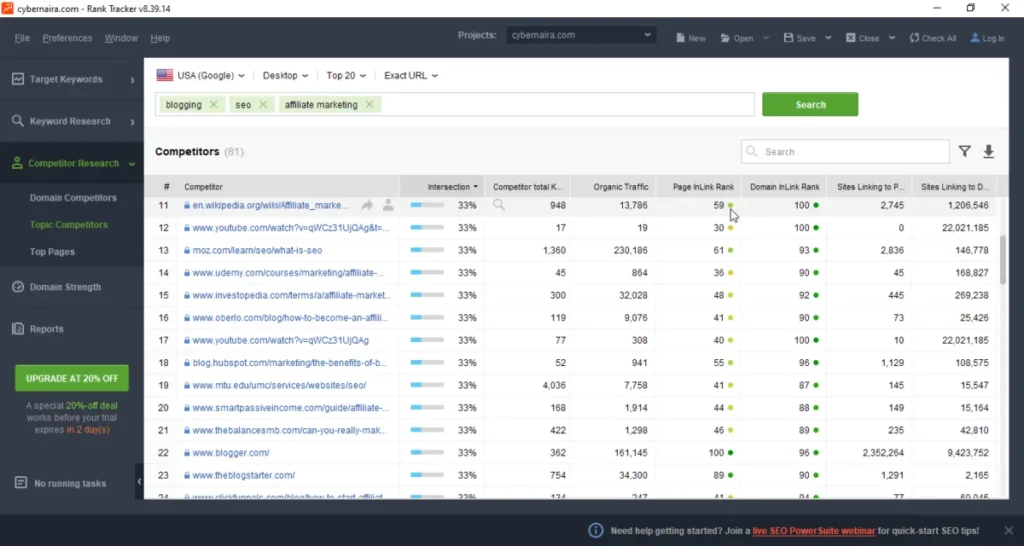
The competitive topic method lets you conduct an effective keyword strategy on niche topics. This method is ideal for starting in a new niche.
Don’t you know which competitor’s website it is?
Also, you can use additional metrics on this page to optimize.
For example, you can start your link-building analysis by using the sites linking to pages and the sites linking to the domain columns.
Play around on this page to see what you can make from the data.
Top Pages
Finding top pages on your competitor’s website is as easy as tapping your finger.
Enter your target competitors’ domain URLs and wait a few minutes for reports on top-ranking pages and their metrics, such as inline ranking, Domain Inline Rank, keyword intersection, etc.
This page contains several helpful pieces of information that can significantly benefit your marketing strategies. You can see the estimated organic traffic for the past 30 days on the page.
The traffic value and the number of ranking keywords for the exact page. The top-ranking queries, estimated organic traffic, and the top keyword for the past 30 days.
You could also compare up to 10 competitor websites side by side,
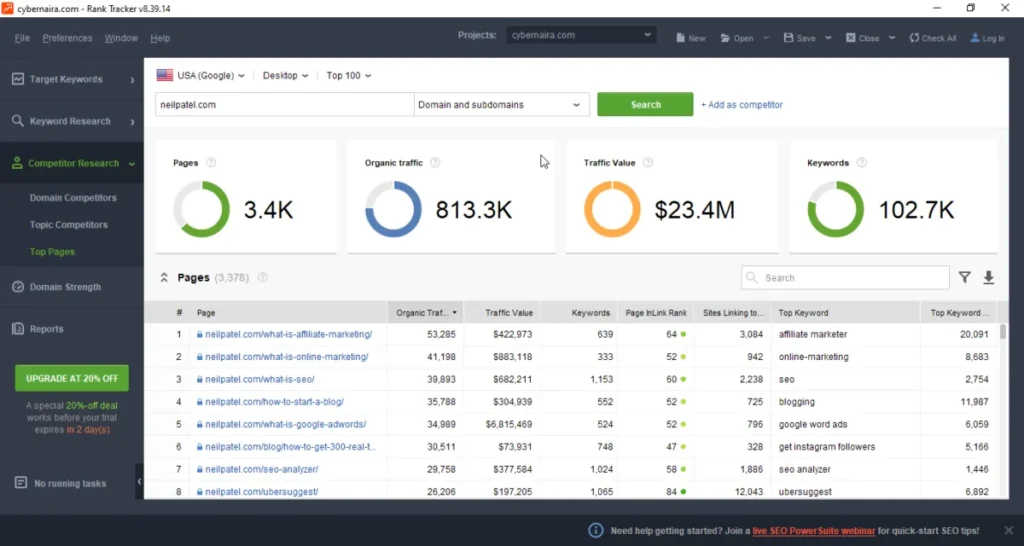
The good thing is that you can use the built-in browser to review the top pages on the competitors’ websites. This will help you gather detailed information and SEO checklists to inform your content optimization strategies.
Domain Strength
The domain strength feature provides a detailed analysis of your website’s authority.
The website’s authority ranges from 0 to 10, with 0 being the lowest and 10 the highest.
Domain strength is a complex SEO metric developed by SEO Powersuite. It is calculated based on several factors, including domain age, link quality, social signals, and content quality.
This information will help you track the progress of your SEO campaigns over time. Checking the SEO strength of the website neilpatel.com reveals an impressive score of 9.10/10.
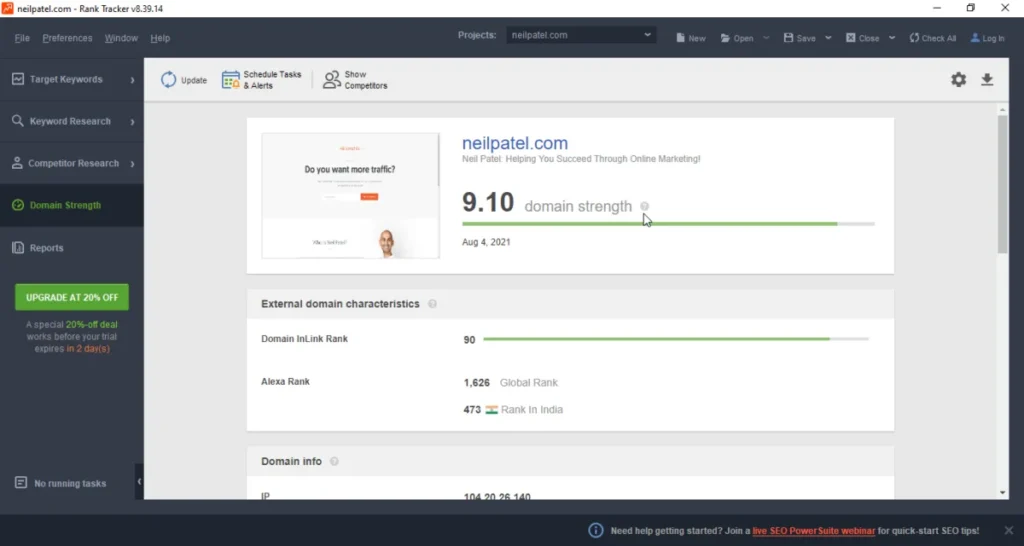
There are other helpful SEO metrics for websites on this page.
You get an overview of Alexa website traffic data and domain info – such as IP address, domain age, country, etc.
Also, you get an overview of the number of indexed pages in Google, Bing, and Yahoo, website backlink profile statistics, and the percentage of do-follow and no-follow incoming links.
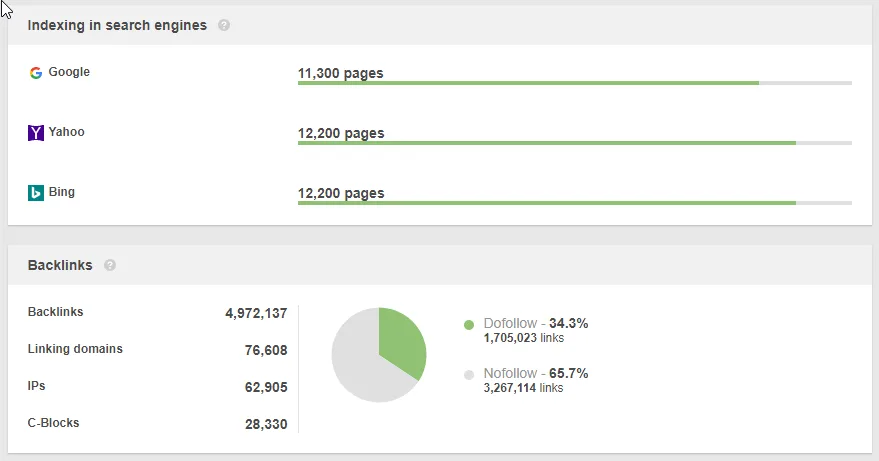
In addition, Rank Tracker also pulls website traffic data from your Google Analytics. So, you must allow the connection with your GA4 account to review the data.
Reports
The report section is the icing on the cake for you if you’re an SEO agency or local SEO services specialist.
First, you’ll get a detailed overview of all the analyses you’ve been doing. The report template is broken down into eight sections. Each section comprises your SEO analysis history within the tool, and it’s broken into:
Each section gives an overview of the history of SEO analysis.
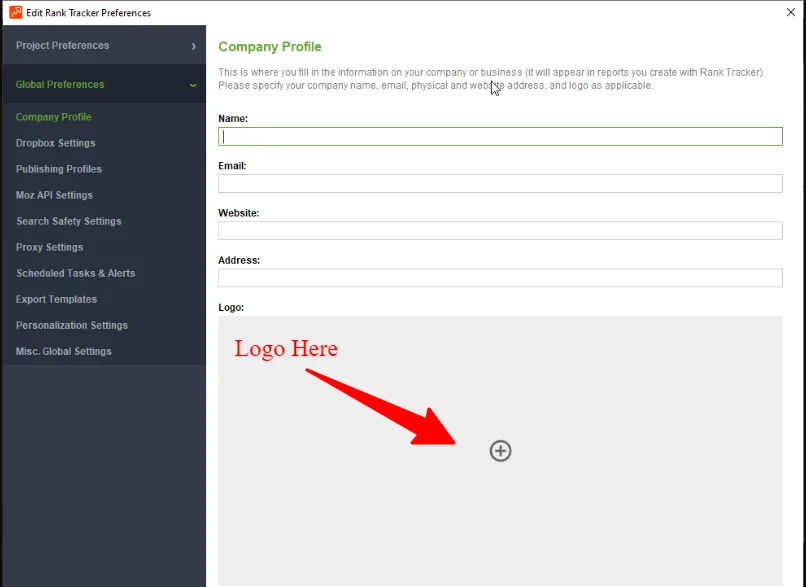
If you do SEO for clients, you can send branded client reports via PDF with your company’s name, logo, email address, website, and address.
This makes your SEO report more professional and personalized.
Rank Tracker Pricing
There are three tiers of the Rank Tracker license plan.
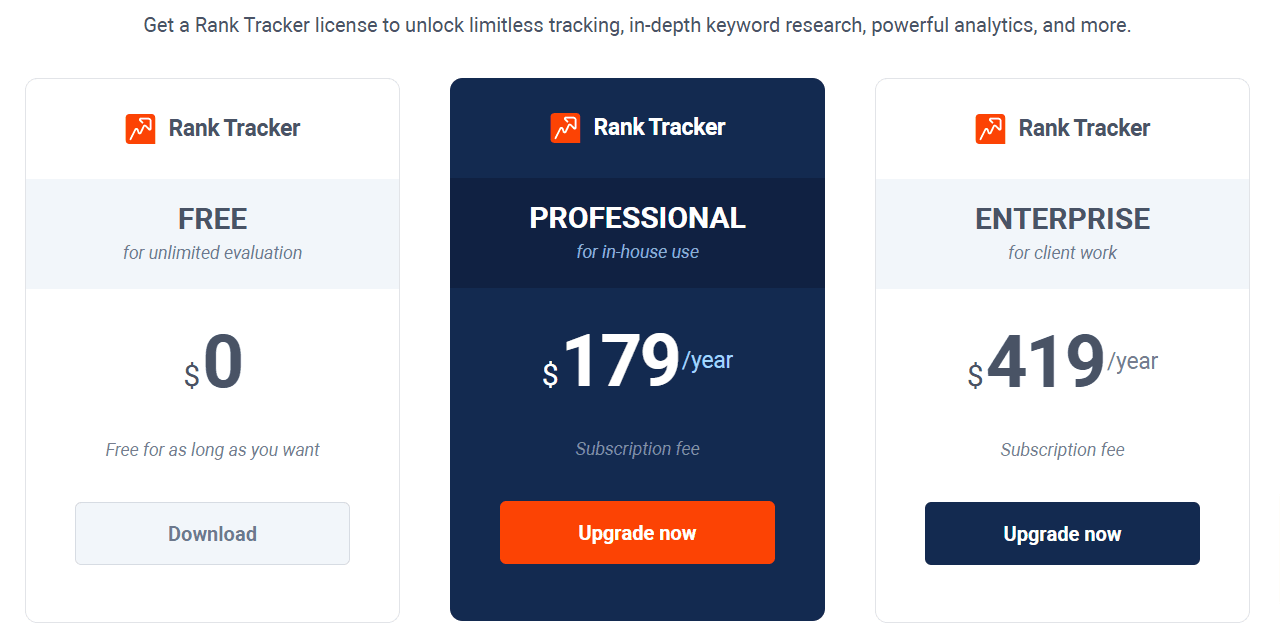
Considering that other SEO tools like Semrush and Ahrefs are priced higher for similar features, you’ll agree that the yearly price is well justified.
Besides, the SEO Powersuite bundle kit offers lifetime licenses with discounts of up to 34% on multiple-year subscriptions.
The Semrush Guru plan, which allows tracking up to 1,500 keywords for all projects, costs $229.95/month.
The standalone Enterprise license, which allows unlimited position tracking for over 40 websites, costs $419/year.
This is a great deal you should grab.
Rank Tracker Supports
Customer support is one of the advantages of using Rank Tracker.
In addition to the regular support ticket, the SEO Powersuite Facebook user group is beneficial. The group consists of active users who share experiences using the products.
If you have issues using the software, reaching out to the community can be more valuable. For example, here are some questions from other users and helpful insights from community members, especially the group admin.
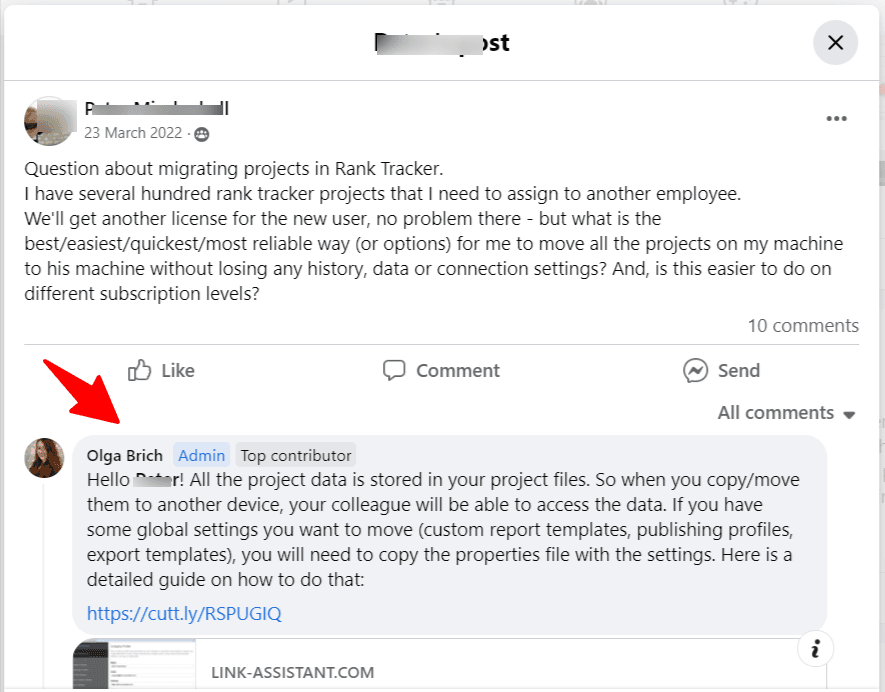
This is just one of the customer support channels available to resolve your issues.
If you prefer email support ticketing, a live chat widget on the website, and all social media options, they are available to resolve your issue.
There are tutorials, video content, on-demand webinars, manuals, and hundreds of knowledge base articles created to help users from downloading the software to getting the best out of it. You’re not left alone to figure things out.
Pros and Cons of Rank Tracker
Despite being feature-rich and helpful, the software has its pros and cons. Let’s review some of the notables so you can set realistic expectations and get to know the software better.
Here are the pros and cons of Rank Tracker from SEO PowerSuite:
Pros
Cons
Overall, Rank Tracker is a powerful and cost-effective tool for brands and marketers who want to monitor competitors and optimize their SEO strategy.
However, it’s better suited for users who prefer desktop-based tools and don’t mind a slight learning curve.
Comparison with Other Tools
RankTracker is often compared to other SEO tools, including SE Ranking, Mangools, Nightwatch, Accuranker, Ahrefs, SpyFu, Moz, and Serpstat.
While each tool has unique features and advantages, RankTracker stands out for its affordability, user-friendly interface, and comprehensive feature set.
It is an excellent choice for small businesses and marketing teams looking for an all-in-one SEO solution.
Unlike some competitors, RankTracker offers a balanced mix of advanced features and ease of use, making it accessible to beginners and seasoned SEO professionals.
Whether you need detailed keyword analysis, competitor insights, or comprehensive rank tracking, RankTracker provides a reliable and cost-effective solution to meet your SEO needs.
FAQ – Review of Rank Tracker From SEO Powersuite
How Much Does Rank Tracker Cost?
Rank Tracker has three license plans: free, professional, and Enterprise. The free plan is available to everyone. You don’t need a payment method to access the download file. The Professional license costs $179 per year, and the Enterprise license costs $349 per year.
Is Rank Tracker From SEO Powersuite Free?
Rank Tracker is available in free and premium licenses. The free plan suits beginners with limited needs for SEO, marketing data, and features.
How Does Rank Tracker Work?
Rank Tracker is a keyword position-tracking tool that helps SEOs track keywords’ position in SERPs. With Rank Tracker, SEO professionals can measure the performance of their keywords in Google, Bing, and Yahoo. etc., and use the data to optimize for a higher ranking.
How to Rank on Google for Free?
Create valuable and helpful content regularly. Study the SERP for your target keyword, and analyze what competitors are doing to rank higher. Build backlinks to your content from authoritative, relevant sites, and promote it to your target audience. If you do these things regularly, your content will rank higher on Google and possibly drive free traffic to your site.
Conclusion
Rank Tracker is one of the best keyword-tracking tools in the market. However, other keyword position-tracking tools exist, such as Pro RankTracker, Semrush, Ahrefs, etc.
However, given the accuracy and freshness of keyword data and the database sizes across primary Google rank-checking tools, it is worth noting that Rank Tracker from SEO Powersuite offers good value for money.
It provides more accurate tracking and keyword optimization. It provides an in-depth analysis of your ranking and your competitors’ rankings.
For SEO agencies, Rank Tracker gives maximum return on investment.


Hey, Thanks a lot for sharing this amazing review. I appreciate it a lot.
You’re welcome, Priya.
Great Tool , It works for as your ranking tracker ,
can easily track website rank and have many advantages.
Thanks, Tejal,
Glad you find Rank Tracker helpful.
Thanks for introducing rank tracker, will check it out
Glad you like it, Dickson.
Finally–an unbiased review of Rank Tracker! I have read a few so far as am contemplating using this vs relying on my paid Ubersuggest (which is really not at all adequate!) As a blogger )on Buddhism) I can spot a product review that is just after the affiliate click–and yours was more than those. Thanks for the time and effort you put in to this.
Hi, Tom,
Glad you find this helpful. If there’s anything I can help with, let me know. Thank you.
After reading your review, I’m definitely gonna try Rank Tracker.
Hi, Sanu,
If you ever need help using the tool, don’t hesitate to get in touch. Thanks and glad to read you’ll try Rank Tracker.
Hi Shamsudeen,
which keyword research and analysis tool do you think is the best?
I’m using free versions and I’m just wondering which premium version to buy.
Hi, Erik,
Good to read from you after a long time, and thanks for visiting. Well, I have used a few keyword research and analysis tools, I pick Semrush keyword magic and Rank Tracker from SEO Powersuite as my go-to keyword tool.
These tools are well up to date with a very massive keyword database – billions of keywords. I hope this helps?
Thanks, Erik.
I go through the article and found it very helpful for visitors. You have shared valuable information for readers and I hope you will continue to serve the community with the latest information.