

Fiverr has over 500k active sellers in over 700+ gig categories. That number is both the platform’s biggest strength and its biggest problem.
Finding a reliable freelancer on Fiverr is entirely possible. I’ve hired designers, SEO specialists, dropshipping freelancers, and marketing contractors through the platform, and several of those working relationships have delivered real, measurable results across several projects.
But finding the right person inside a marketplace that size, without a clear vetting process, is how buyers end up overpaying for disappointing work and concluding the platform isn’t worth using.
The difference between a bad Fiverr experience and a good one is almost always the same thing: how thoroughly you evaluated the seller before placing the order.
This guide is built around that evaluation process. It covers nine steps I use to vet and hire freelancers on Fiverr. From defining the brief before you start searching to spotting the patterns that separate genuine reviews from inflated ones.
These steps apply whether you’re hiring for a one-time task or building a longer working relationship with a contractor.
If you’re hiring on Fiverr for the first time, start at Step 1 — the brief. It’s the most overlooked part of the process and the one that most determines whether the final delivery meets your expectations.
If you’ve hired on the platform before but haven’t been happy with the results, the answer is almost always in Steps 6 and 7 of this guide – reviews and communication. That’s where the vetting breaks down for most buyers.
One important note before we get into it: this guide is specifically about hiring; finding, evaluating, and choosing the right seller.
If you need a walkthrough of the mechanics of placing an order, managing delivery, and handling payment, that’s covered separately in the “How to Buy on Fiverr guide.
Quick Answer:
How Do You Hire the Right Freelancer on Fiverr as a First-Time Buyer?
Define your project requirements clearly before searching. Use Fiverr’s search filters to narrow by seller level, budget, and delivery time. Review the seller’s gig description, portfolio, and star ratings in detail. Contact the seller with a specific question before ordering to assess their communication and expertise. Start with a small order before committing to a larger project.
Step 1: Define Exactly What You Need
Before you open Fiverr’s search bar, your brief needs to exist in writing.
This sounds obvious, but most buyers skip it anyway. They search for “SEO freelancer” or “logo designer,” browse through results, pick someone who looks good, and write the project brief inside the Fiverr order form after they’ve already paid.
That sequence is backwards, and it’s the root cause of most disappointing Fiverr experiences.
NOTE:
Fiverr is launching its Post a Project Brief feature soon, where you can write inside the Fiverr platform. How this will work is still unknown, since the project is in beta. I will update this post as soon as I try it.
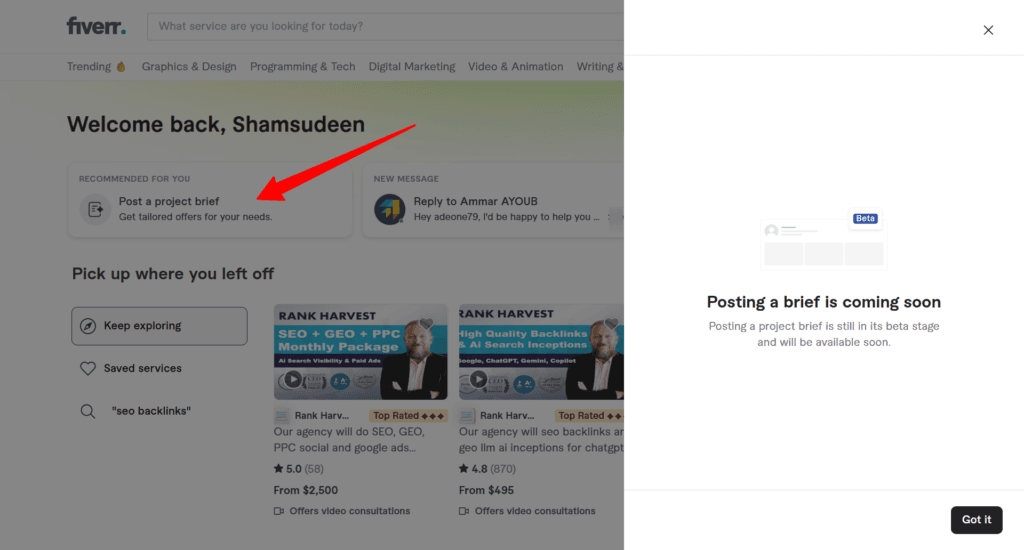
A freelancer can only deliver what they’ve been told.
Even an exceptional seller working from a vague brief produces output that misses the mark. This isn’t because they lack skill, but because they made assumptions about what you wanted that turned out to be wrong.
The revision requests, the back-and-forth, the final delivery that’s technically correct but not what you envisioned. These almost always trace back to an unclear brief.
What a Useful Brief Covers
Before searching for a seller on Fiverr, write down the answers to these questions:
What is the specific deliverable?
It is not “I need SEO help”, but “I need a 1,500-word SEO-optimized blog post on keyword research tools, targeting affiliate marketing beginners, with internal links to three existing posts.”
The more specific the output, the more accurately you can evaluate whether a seller’s gig actually covers it.
What does success look like?
Define the outcome you’re trying to achieve, not just the task.
For example, “Increase my site’s domain rating” is an outcome. “Build 10 backlinks” is a task.
A good freelancer needs to understand both to decide how to approach the work.
What are your non-negotiables?
Turnaround time, word count, file format, revision rounds, communication language, or tools used.
Anything that would cause you to reject a delivery if it doesn’t meet the standard belongs in the brief before you search, not after you’re already in a dispute.
What existing materials does the freelancer need?
Brand guidelines, existing content, login credentials, style examples, and reference URLs.
Knowing this up front helps you communicate requirements clearly in the first message and avoid delays after ordering.
Why This Matters More on Fiverr Than Other Platforms
On traditional freelance platforms like Upwork, you post a job description and freelancers pitch you, so the brief exists by design before any money changes hands.
On Fiverr, the model is reversed: you browse pre-packaged gigs and order from them. There’s no natural forcing function to write your brief before engaging with a seller.
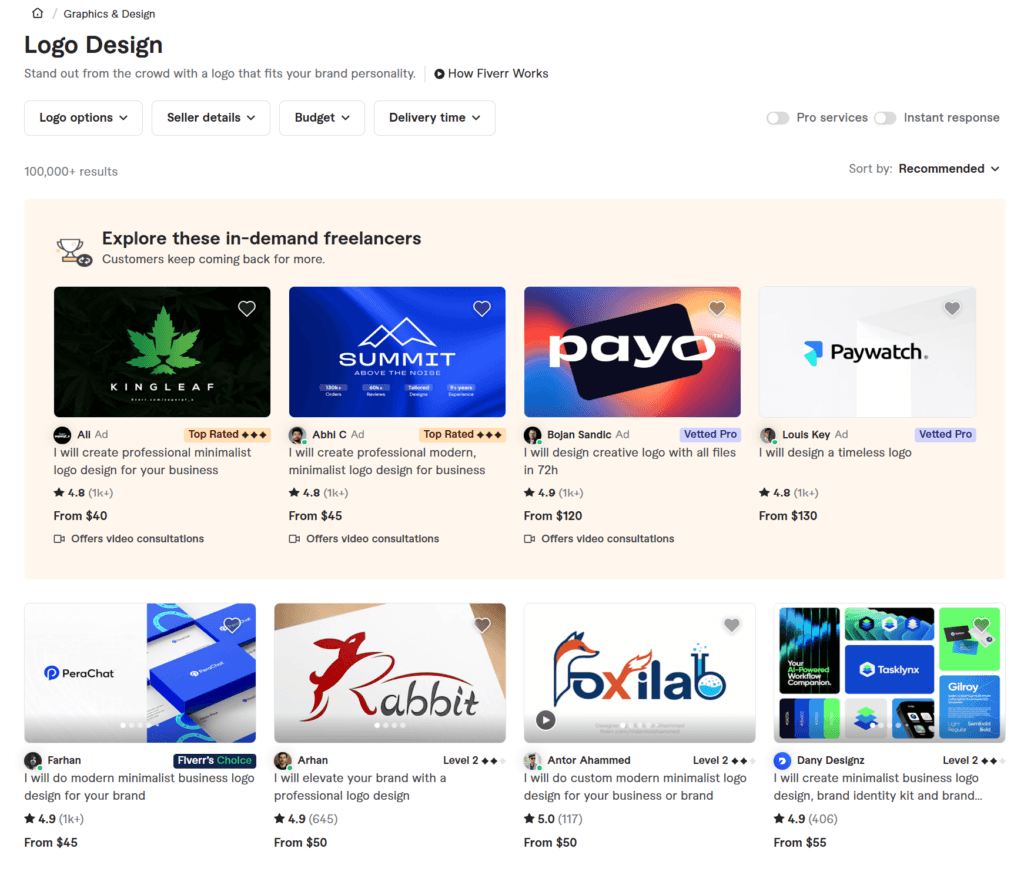
That structural difference is why brief clarity matters more on Fiverr, not less. Without it, you’re evaluating sellers based on their gig packaging rather than their fit for your specific project, and those are two very different things.
From my own experience hiring on the platform: the orders that delivered the best results were always the ones where I went in with a written specification.
The ones that required the most rounds of revision, or that I ultimately wasn’t happy with, were the ones where I searched first and figured out what I wanted after finding someone I liked.
Both sequences feel equally natural at the moment. Only one of them consistently works.
Step 2: Use Fiverr Search Filters Strategically
Fiverr’s default search ranking is an algorithm that prioritizes sellers based on a combination of gig performance metrics, review volume, return customers, and paid promotion.
The top results are not necessarily the best sellers for your project. They’re the sellers who’ve optimized their gig listings most effectively or who’ve paid for placement. Both are separate skills from the actual work you’re hiring for.
Filters are how you cut through that noise and find sellers who match your actual requirements.
How to Use Fiverr Search Filters Effectively
After running your initial keyword search, apply filters in this order:
Category and subcategory first.
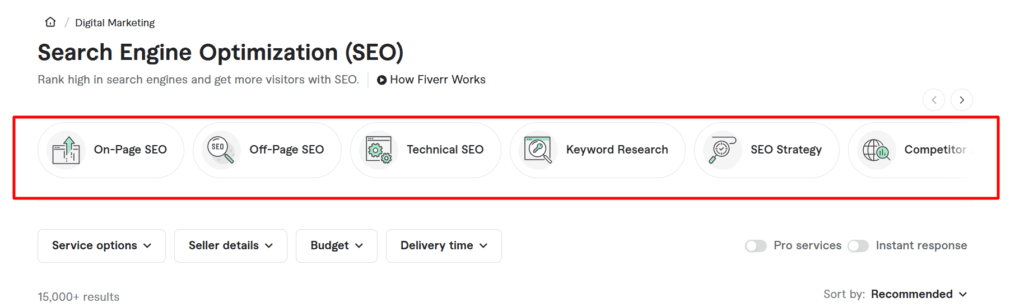
Fiverr’s category structure is more granular than the search results suggest. Before applying any other filter, make sure you’re in the right subcategory.
The search term “SEO” can return gigs across six subcategories, like on-page SEO, link building, technical SEO, local SEO, SEO audits, and more. Narrowing to the right subcategory before filtering immediately removes hundreds of irrelevant gigs.
Seller level next.
This is the most important filter for first-time buyers on Fiverr and is covered in detail in Step 3. For now, filtering to Level 2 or Top Rated Seller significantly reduces the risk of a poor first experience.

New Seller and Level 1 gigs can deliver excellent work, but evaluating them requires more effort, which is better suited to buyers who already understand how to read a seller’s signals.
NOTE:
Under the top-level filter, “Seller Details“, you can filter by Seller type (Agency or Solo freelancers), location, hourly rate, language, and availability.
Budget.
Set a realistic range before filtering, not a minimum price. On Fiverr, the cheapest option in any category is almost never the best value.
It’s either a new seller building their review base, a seller using the low-price gig as a lead magnet for upsells, or an experienced seller who has specifically priced for volume over quality.
Set your budget based on what the work is worth, then filter to see what’s available at that range.
For example, I set a $300 budget for this project, and Fiverr filtered relevant gigs within that range.

Delivery time.
Only apply this filter if the deadline is genuinely a constraint. Filtering by delivery time removes sellers who do high-quality work but build realistic timelines into their gigs, which is often a sign of professionalism rather than slowness.
If you’re not working against a hard deadline, leave this filter off and evaluate delivery time seller by seller.
Pro Verified.
Fiverr Pro is a separate verification tier in which sellers are manually vetted by Fiverr’s team for professional-grade quality.
Pro gigs are priced significantly higher than standard gigs but come with a meaningful quality floor.

If your project has a high business impact – a critical piece of content, a website redesign, a strategic consultation – filtering to Pro Verified is worth the premium.
Refining Your Search With the Right Keywords
The keyword you enter in the search determines which pool of sellers you’re filtering. Broad keywords return broad results. Specific keywords return results that better match your actual needs.
The same principle from your brief applies here: specificity produces better matches.
“SEO” returns thousands of results across dozens of subcategories. “Technical SEO audit WordPress” returns a much smaller, more relevant pool. “Link building SaaS niche” is more useful than “link building.”
For example, if you’re hiring a Yoga instructor for an online course, the difference between searching “yoga instructor” and “yoga online course beginner female instructor” is the difference between browsing a city-wide directory and walking into a room of people who match your exact criteria.
Use your brief to generate the search terms rather than searching first and figuring out what you want from the results.
Step 3: Understand Seller Levels Before Shortlisting
Fiverr uses a tiered seller-level system that indicates how long a seller has been active on the platform, how consistently they’ve performed, and, in some cases, whether they’ve been manually vetted for professional credentials.
Understanding what each level actually means — and what it doesn’t — prevents both over-relying on it as a quality signal and dismissing lower-tier sellers who might be the right fit.
The Five Seller Levels
New Seller
New Sellers who have recently joined the platform and have no order history or reviews yet.
They’re unverified in any meaningful sense. Fiverr hasn’t had enough transaction data to evaluate their consistency, communication, or delivery quality.
New Sellers are not automatically bad hires. Many experienced professionals join Fiverr and price their gigs below market rate specifically to build their review base.
Some of the best value hires on the platform are New Sellers with strong portfolios and clear, detailed gig descriptions who are actively trying to establish their reputation.
The risk is proportionally higher because there’s no performance history to evaluate. If you hire a New Seller on Fiverr, apply all the other vetting steps in this guide more rigorously.
Particularly, the portfolio review and pre-order communication steps, and start with the smallest available order to test before committing to a larger project.
Level 1
Level 1 Sellers have completed at least 10 orders, maintained a high satisfaction rating, and been active on the platform for at least 60 days.
It’s the first tier that requires demonstrated performance rather than just account creation.
A Level 1 badge means the seller has demonstrated they can consistently complete orders and satisfy buyers, but the sample size is small.

Ten orders are enough to confirm basic competence and reliability, but not enough to identify how a seller performs across different project types, with different buyer communication styles, or under deadline pressure.
Level 1 is a reasonable entry point for lower-stakes projects where price is a meaningful constraint, and you’re willing to thoroughly vet the gig itself.
Level 2
Level 2 Sellers have completed at least 50 orders, maintained high ratings for at least 120 days, and demonstrated consistent performance across a larger sample of buyers.
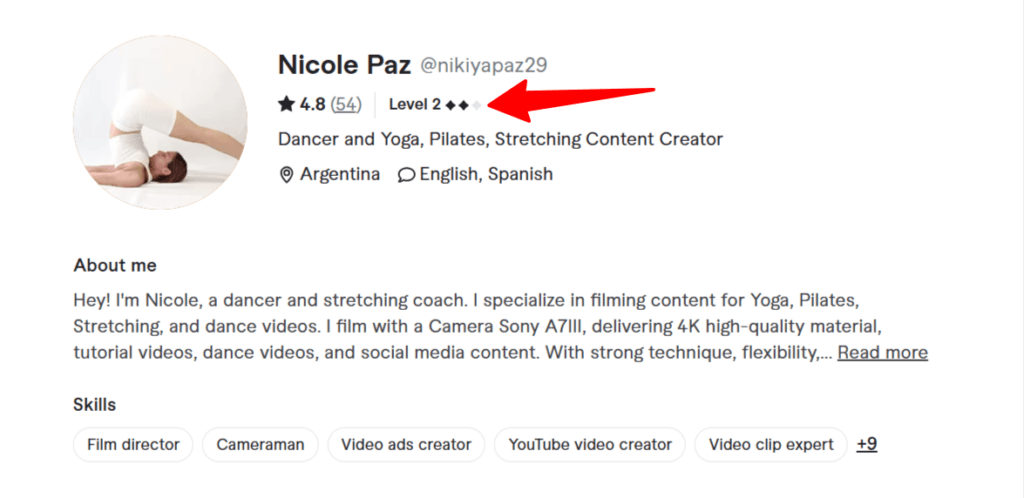
At this tier, the performance data is meaningful — 50+ orders across four months give a genuine picture of how a seller operates.
Level 2 is the minimum recommended tier for projects with meaningful business impact. This includes content that will be published on your blog, SEO work that will affect your rankings, and design work that will represent your brand.
The combination of volume, consistency, and duration at Level 2 significantly reduces the risk of the avoidable problems that derail lower-tier hires.
Top Rated Seller
Top Rated Sellers sit at the top of Fiverr’s standard seller hierarchy. The requirements include at least 100 completed orders, $20,000 in lifetime earnings, consistently high ratings maintained over an extended period, and a manual review by Fiverr’s team.

Unlike lower tiers, which are awarded automatically when metrics are met, Top Rated status requires human evaluation.
What that manual review means in practice: Top Rated Sellers have been assessed not just on volume and ratings but on overall quality of service, buyer satisfaction, and professional conduct on the platform.
For Fiverr first-time buyers who don’t want to spend significant time on due diligence, defaulting to Top Rated Sellers substantially reduces that burden.
The tradeoff is price. Top-rated gigs are typically priced higher than equivalent Level 2 gigs, and at the top end of any category, the price difference can be significant.
Whether that premium is worth it depends on your project’s stakes and how much time you’re willing to invest in vetting a lower-tier seller more thoroughly.
Pro Verified
Fiverr Pro is a separate tier from the standard seller level system, not the next step above Top Rated, but an entirely different qualification track.

Pro Sellers have been manually vetted by Fiverr specifically for professional credentials, including relevant industry experience, portfolio quality, and demonstrated expertise at a professional, rather than freelance, level.
Fiverr Pro gigs are priced at professional market rates rather than the competitive rates typical of the standard marketplace.
A Pro copywriter, for example, is priced comparably to what you’d expect to pay an experienced freelancer through a professional agency, not the $15–50 range typical of standard Fiverr gigs.
Pro Verified is the right tier when the project has a high business impact and the cost of a poor outcome (in time, money, or brand damage) exceeds the premium on the Pro gig.
Think critical website copy, strategic consulting, complex technical builds, and high-visibility design work are all candidates for Pro verification.
What Seller Level Doesn’t Tell You
Seller level is a proxy for consistency and track record, but not for fit with your specific project.
A Top Rated Seller with 400 reviews for writing fitness content is not automatically the right hire for technical SEO content, regardless of their rating.
A Level 2 seller who has completed 60 orders specifically in your niche may be a significantly better match.
Use seller level as the first filter in your shortlisting process to narrow the candidate pool by eliminating sellers whose track record doesn’t meet a minimum threshold.
Then use the following steps to evaluate fit: Does their portfolio match your project type? Does their gig description address your specific requirements? And does their communication in direct messages reflect the expertise you need?
Seller level gets you to candidates worth evaluating. The evaluation itself starts at Step 4.
Step 4: Contact the Seller Before Ordering
Sending a message before placing an order is the single highest-leverage action you can take to reduce hiring risk on Fiverr. It costs you nothing except a few minutes, and the information it returns is impossible to get any other way.
When you message a seller before ordering, you’re not just asking a question; you’re running a low-cost evaluation across four dimensions simultaneously:
Response time
How quickly a seller responds to a pre-order message is one of the most predictive signals of how they’ll communicate throughout the project.
A seller who takes 48 hours to respond to an inquiry will likely take 72 hours to respond to a revision request or a delivery question.
Fiverr displays each seller’s average response time on their profile, but a direct message gives you a real data point rather than a platform average.

Communication quality
Read the response carefully:
A well-written, specific response from a seller you’re considering hiring is a strong positive signal. A generic, template-feeling response from the same seller is a yellow flag worth noting.
Subject matter competence
Ask a question that requires actual expertise to answer well. Not “can you do this?” Instead, ask something that reveals how the seller thinks about the work.
For an SEO gig, you can ask: “How would you approach building links for a relatively new blog in the affiliate marketing niche that doesn’t have much domain authority yet?”
A seller with genuine expertise gives a substantive, nuanced answer. A seller who can fulfil orders but doesn’t deeply understand the subject gives a vague or generic one. Both types exist at every seller tier.
Fit with your specific brief
Use the pre-order message to share the key details of your project and ask whether they fall within the seller’s gig.
Gig descriptions are written to attract the broadest possible audience; they don’t always reflect what the seller is actually best at or most comfortable delivering.
A direct conversation surfaces mismatches before they become post-delivery disputes.
What to Say in Your First Message
Keep it short, specific, and easy to respond to. A wall of text asking fifteen questions gets a proportionally shallow response. One or two focused questions get a focused answer.
Here’s a useful format you can copy:
“Hi, I’m working on [brief project description in two sentences]. My main requirement is [one specific, non-obvious requirement from your brief]. A couple of questions before I order: [specific competence question]. Does your [specific gig package] cover this type of project?”
This format accomplishes three things:
What the Response Tells You
A response worth proceeding with is one that answers your specific question directly, adds relevant context you didn’t ask for that shows the seller is thinking about your project, and asks at least one clarifying question about your requirements.
That last point: a seller asking you a question back is consistently one of the strongest positive signals available. It means they’re thinking about fit, not just about securing an order.
A response that should give you pause is when the seller restates the gig description in different words, confirms they can do the work without engaging with the specifics of your question, or responds to a message about an affiliate marketing SEO task by saying, “I have 5+ years of experience in SEO and would love to work with you.”
Technically, that might be true, but not really useful in your case. That also shows a preview of the communication quality you’ll get during the project.
Some responses that should end the conversation:
The Gig Note That Most Buyers Miss
Many sellers put critical working conditions in their gig description that only become relevant after you’ve paid. Requirements like availability for video calls, specific materials the buyer must provide before work begins, or restrictions on usage rights.
Reading the description before messaging doesn’t replace messaging before ordering.
The description tells you the seller’s standard conditions. The conversation tells you whether those conditions work for your specific situation, and whether this particular seller is someone you want to work with.
Step 5: Read the Full Gig Description
A gig description is the seller’s contract with you before the order starts. Reading it fully takes two minutes.
Not reading it is how you end up in a revision dispute over a misunderstanding that was documented clearly in the description the whole time.
What to Look For in the Gig Description
Specificity about deliverables
A strong gig description tells you precisely what you receive: the word count, the number of revisions, the file formats, the turnaround time for each package, what’s included, and what’s explicitly excluded.
A weak one uses broad language — “high quality SEO content,” “professional design,” “comprehensive audit“, without defining what those terms mean in practical output terms.
Compare:
“I will write a 1,200–1,500-word SEO blog post optimized for one target keyword, including a meta title and meta description, and one internal link suggestion. One round of revisions within 48 hours of delivery” versus “I will write an amazing SEO article that will rank on Google.”
Both might be from experienced writers. Only one tells you what you’re actually buying.
What’s excluded?
The most important sentences in many Fiverr gig descriptions are the ones that tell you what the gig does not cover.
Source images, SEO keyword research, WordPress publishing, content strategy, paid tool access, and competitor analysis. These are commonly excluded from gigs that imply they’re included in the title.
Read the gig exclusions before evaluating the price.
Working conditions
Some sellers include requirements that meaningfully affect whether the gig works for your situation. Like availability for video calls, a requirement to provide specific materials before work begins, response-time expectations during the project, or restrictions on commercial use.
Any condition that would be a problem for your workflow needs to be identified before ordering, not after delivery.
Package differences
Almost every Fiverr gig offers three packages: Basic, Standard, and Premium. Read all three before deciding which to order.
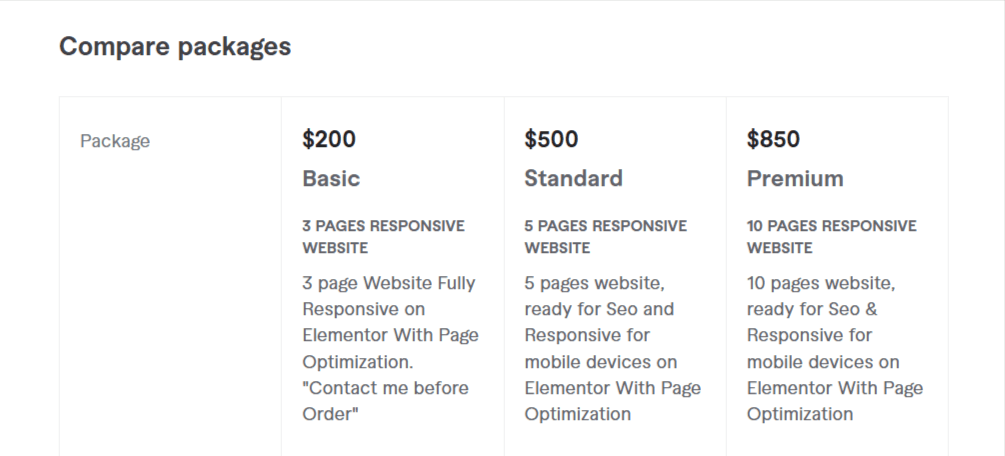
The cheapest package on a gig priced to upsell is sometimes deliberately limited to drive buyers toward the mid- or top-tier.
The premium package on a gig from a deep-expertise seller is sometimes the most cost-effective option because it includes deliverables that would require multiple basic orders to replicate.
Pay particular attention to the revision count across packages. A Basic package with zero revisions is a higher-risk order than a Standard package with three, even if the price gap seems significant.
One round of “this isn’t quite right” with no revision allowance means starting the process over from scratch.
Gig FAQs
Most sellers include an FAQ section below the main gig description. These are the questions the seller has been asked repeatedly, which means they’re almost certainly the questions that caused the most confusion or dispute on previous orders.
Most of the time, if the gig requires any materials from you to get started, the seller includes them in the FAQ section. Also, if a seller has an FAQ entry explaining what their gig doesn’t include, that’s information previous buyers learned the hard way.
So read them.
Gig extras
Fiverr allows sellers to offer add-ons such as faster delivery, additional revisions, source files, commercial use rights, and extra keywords.
Review these before ordering.
Some add-ons are genuinely optional. Others, like commercial usage rights for design work you plan to publish, or source files for a logo you’ll need to resize in the future, are effectively required for your use case.
And their cost needs to be factored into the real price of the gig before you compare it to alternatives.
What the Gig Writing Quality Tells You
For any gig that involves written deliverables — content writing, copywriting, email sequences, product descriptions, ad copy — the gig description itself is a writing sample.
A compelling, well-structured gig description from a content writer signals they can write.
A gig description full of grammatical errors, awkward phrasing, or unclear sentence structure from the same seller tells you exactly what to expect from their paid work.
Step 6: Review Work Samples and Portfolio
A seller’s portfolio is the closest thing to a guarantee available on Fiverr.
Customer reviews tell you how buyers felt about working with the seller. A portfolio tells you what the work actually looks like.
These are different types of evidence, and for projects where output quality is the primary variable, portfolio review is more reliable than past customer review volume.
A seller with 200 five-star reviews and a portfolio of mediocre design work will deliver mediocre design work for your project.
A seller with 30 reviews and a portfolio that demonstrates the exact quality level you need is a better fit for a design project, regardless of the difference in review counts.
Where to Find Portfolio Work on Fiverr
Fiverr offers sellers three ways to display past work, and you should check all three before shortlisting a candidate.
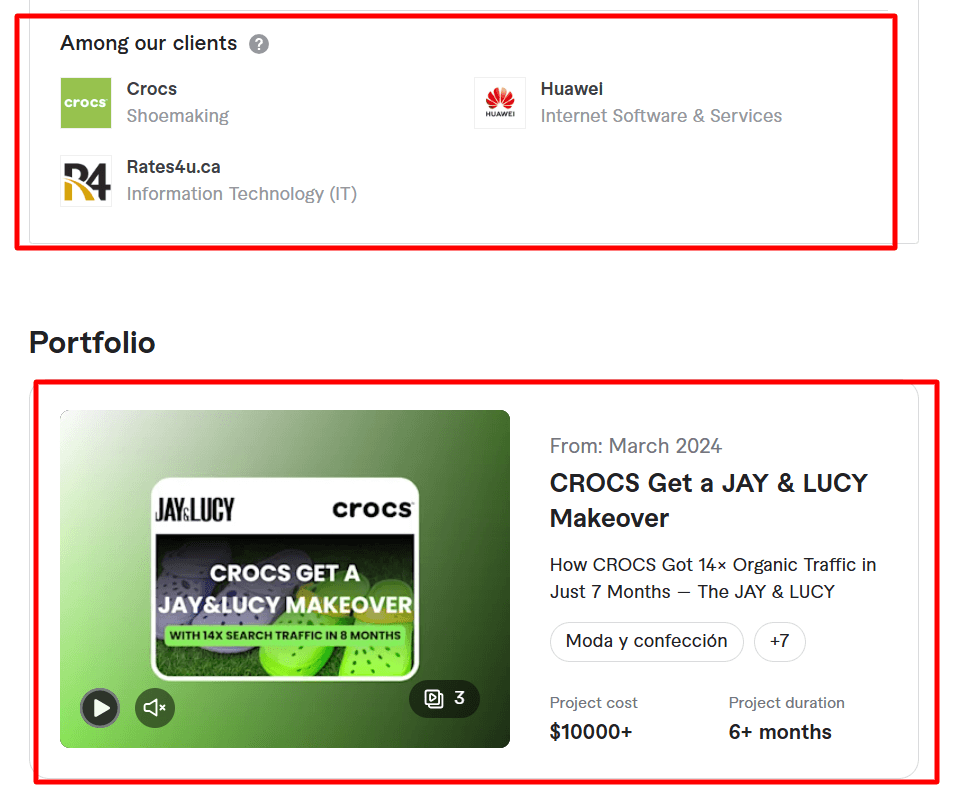
The Fiverr Portfolio feature allows sellers to attach work samples and notable clients directly to their gig listing page. These appear as a gallery beneath the gig description and packages — images, PDFs, videos, or document previews depending on the service type.
The seller profile page (separate from the gig listing) sometimes includes additional portfolio items and a bio section where sellers describe their background and expertise.
The profile page also shows the seller’s complete review history across all their gigs. This is useful if a seller has strong performance in one category with few reviews but has built a reputation in other service areas.
Direct request: For services where the most relevant work isn’t publicly displayable, such as confidential client content, private website builds, or ghostwritten articles, the portfolio on the listing may underrepresent what the seller has actually produced.
A direct message asking for relevant samples, with context about your project, is a reasonable request.
The response to that request, whether they share relevant samples promptly, explain confidentiality constraints, or simply don’t respond, is itself a useful signal.
How to Evaluate What You See
Match the samples to your specific project: A graphic designer’s portfolio might include logo design, social media templates, infographics, and presentation decks.
If your project is a logo, the relevant evaluation is their logo samples, not whether their infographic work looks good.
Assess quality against your standard, not the platform’s: The benchmark for Fiverr portfolio work isn’t “is this impressive for a $15 gig”. It’s “Does this meet the quality standard I need for my project?”
Evaluate against your requirements, not against the implied standard of the platform tier.
Look for range and consistency: A portfolio with ten samples, all excellent, is more informative than a single sample that’s outstanding.
Range tells you the seller can deliver consistently, not just on one lucky project.
Check the dates where visible: A portfolio of strong work from 2019–2020, followed by nothing recent, warrants a direct question about whether the work shown is still representative of their current output.
What Absence of Portfolio Work Tells You
For services where portfolio work should be available, such as design, video production, animation, and writing, the absence of a portfolio is a significant signal.
It means one of three things: the seller is new and hasn’t built one yet, the seller hasn’t prioritized showing their work, or the work doesn’t hold up to direct inspection.
If a seller in a portfolio-relevant category can’t or won’t provide examples of past work when asked directly, treat it as a red flag. It doesn’t mean they’re bad at their job, but it means you have no evidence they’re good at it.
Step 7: Evaluate Reviews — Real vs Fake
Fiverr customer reviews are the most visible trust signal on the platform and the most actively gamed.
Understanding how to read them and how to spot the patterns that indicate manipulation is one of the most valuable skills a Fiverr buyer can develop.
What the Star Rating Actually Tells You
Fiverr’s star rating system is heavily skewed toward five stars across the platform.
The vast majority of gigs with meaningful review volume sit between 4.7 and 5.0, which means a 4.8-rated seller and a 5.0-rated seller are not as different as the numbers suggest.
The average rating is less informative than the distribution. Before settling on a rating number, look at the breakdown:
How many reviews are five stars vs four vs three? A gig with 200 reviews, 195 of which are five stars and 5 of which are one star, tells a different story than one spread more evenly across four and five stars.
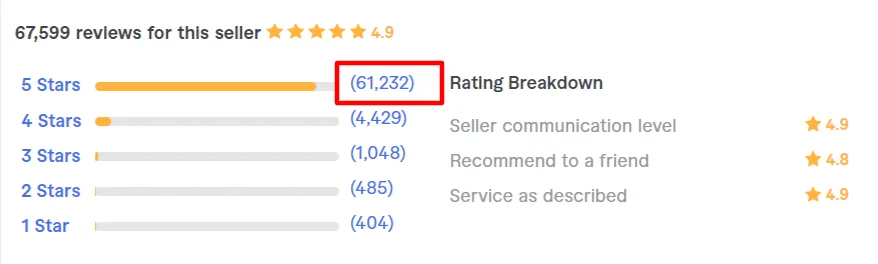
The first pattern (overwhelmingly five stars with a cluster of harsh outliers) is common in gigs where fake reviews inflate the positive rating, and occasional genuine negative experiences break through.
What do the non-five-star reviews say? Negative and mixed reviews are often the most informative text on the entire gig page.
Read them first.
Patterns in the lower ratings, such as multiple buyers mentioning slow communication, revision disputes, or deliverables that didn’t match the brief, are more predictive of your experience than the positive reviews that surround them.
When were the reviews written? Recent reviews are more representative of the seller’s current output quality and responsiveness.
If the most recent reviews are from six months ago, find out why.
How to Spot Fake Fiverr Reviews
Identical or near-identical review text: Read through the first 20–30 reviews and note whether multiple reviews use the same phrasing, sentence structure, or specific words.
Genuine buyers writing independently don’t produce identical review text.
Reviews that don’t relate to the service: A logo design gig with reviews that say “great communication and fast delivery” but say nothing about the logo itself suggests the reviewer didn’t receive or carefully evaluate the deliverable.
Hyperbolic language without specifics: Genuine buyers who received excellent work tend to describe what made it excellent.
Fake reviews over-praise without specifics: “Absolutely outstanding! The best seller on Fiverr, 10/10, will definitely order again!”

The enthusiasm is performative; the content is empty.
Reviewer profiles with only one or two reviews, all on the same seller: Click through to the reviewer profiles for a few of the reviews.
A cluster of single-review accounts all reviewing the same seller is not consistent with organic buyer behavior.
A sudden spike in review volume: A seller who accumulates reviews at a slow, organic pace for months, then sees 50 reviews arrive in two weeks, is exhibiting a pattern consistent with a bulk fake-review purchase.
Step 8: Start Small With Multiple Sellers
Everything in the previous seven steps reduces hiring risk. This step eliminates most of what’s left.
The most reliable way to know whether a Fiverr seller is right for your project is to give them a small version of your project and evaluate the actual output.
Not their gig description, not their portfolio, not their reviews, but their work, on your brief, delivered to you.
Running small test orders before committing to a larger project is standard practice for any buyer who regularly hires on Fiverr.
It’s also the step most Fiverr first-time buyers skip because it requires paying multiple sellers for the same type of work before choosing one, which can feel inefficient.
In practice, the cost of running test orders is almost always lower than the cost of a single large order with a seller who turns out to be the wrong fit.
How to Structure a Test Order
The test order needs to be representative of your actual project to be informative. Take your full brief and identify the smallest self-contained unit of work it contains.
Whatever the unit is, it should be real work you’ll actually use, not a throwaway test that the seller knows doesn’t matter.
Order from two or three sellers simultaneously using the same brief. Keep the brief identical across all test orders.
The point is to compare outputs produced from the same inputs, which means any difference in quality is attributable to the seller, not to differences in what you asked for.
What to Evaluate From the Test
Output quality relative to your standard: Does the work meet the quality level your project requires? Not “is this good for a Fiverr order” — but “would I actually use this?”
Apply your real standard, not a discounted one.
Brief adherence: Did the seller deliver what the brief asked for, or did they deliver a variation of what they thought you wanted?
Sellers who interpret the brief broadly and make assumptions are sellers who’ll require more revision cycles on larger orders.
Communication during the order: Did the seller ask sensible questions before starting the order?
Did they communicate clearly when they delivered?
The quality of communication during a test order reflects what you’ll get on a full project.
Revision response: Request at least one revision on each test order, even if the initial delivery is strong.
How a seller handles revision requests is one of the most important signals in the entire evaluation process.
A seller who responds to a specific, reasonable revision request with a prompt, accurate change and no friction is a seller you can work with at scale.
The Long-Term Value of Test Orders
From personal experience hiring on Fiverr for SEO and marketing work: every long-term freelance relationship I’ve built through the platform started with a test order.
The sellers I’ve returned to repeatedly, mostly for link building, for specific writing and design tasks, or other technical work, all went through the same initial evaluation.
Test orders aren’t just a risk management tool. They’re how you build a reliable roster of go-to Fiverr freelancers over time, sellers you know can deliver your standard, communicate the way you work, and handle revisions without friction.
That roster has compounding value. Every project you need to hire for becomes faster, lower-risk, and more predictable because you already know who to call.
Step 9: Post a Custom Project Request
Every step in this guide up to this point has assumed you can find the right seller through Fiverr’s search and filter system. For most projects in established service categories, you can.
For projects that are highly specialized, unusually specific, or at the intersection of two disciplines that aren’t neatly covered by a single gig category, the search approach sometimes returns nothing that genuinely fits your brief.
That’s when Fiverr’s Post a Request feature proved to be the right tool.
What Post a Request Does
Post a Request reverses the standard Fiverr dynamic. Instead of you browsing sellers and choosing one, you describe your project, and interested sellers come to you with proposals.
It’s the closest Fiverr gets to the traditional freelance marketplace model, where the buyer posts a job, and freelancers pitch for it.
The practical advantage is reach.
A specific keyword search returns only gigs that sellers have explicitly optimized for that search term.
A well-written request reaches sellers across the platform who have the relevant skills but haven’t packaged them in a way your search query would have surfaced.
When to Use Post a Request
Post a Request is most useful in four situations:
Your project is highly specialized: If your brief requires a combination of skills.
Let’s say a writer who understands technical SEO and has experience in the SaaS niche. Another example, a developer who knows both WooCommerce and custom API integrations.
This intersection may be underrepresented in Fiverr’s gig catalog, even if both skills are widely available individually.
Your project is custom enough that no existing gig fully covers it: Your project may have requirements that don’t fit neatly into any available package.
A request lets you describe the full scope and receive proposals tailored to it, rather than adapting your project to fit an existing gig’s structure.
You want competitive proposals before committing: A Post a Request response gives you multiple sellers making their case for your project simultaneously, which provides comparison information that browsing gigs alone doesn’t.
You need someone quickly: A well-written request generates responses from sellers who are actively available and interested in your specific work. This can significantly reduce the time from brief to hired seller.
Red Flags To Watch Out For
Every step in this guide is a positive vetting process: looking for evidence that a Fiverr seller is the right hire.
This section is the inverse: the specific signals that indicate a seller is the wrong one, regardless of how well they perform on other dimensions.
Any request to communicate or transact outside Fiverr.
This is the most important red flag on the platform and the one with the most serious consequences.
If a seller asks you to move the conversation to WhatsApp, Telegram, email, or any other channel, or asks you to pay outside Fiverr’s payment system, stop the conversation immediately and report it.
Fiverr’s buyer protection, dispute resolution, and refund processes all depend on the transaction occurring within the platform.
There is no legitimate reason for a professional seller to need to communicate or transact outside the platform’s tools.
A gig price that’s dramatically lower than every comparable gig.
On Fiverr, unrealistically low pricing is almost always a signal rather than a bargain.
The three most common explanations:
No portfolio in a service category where portfolio work should exist.
A design, video, writing, or development seller who cannot show you relevant previous work, and who doesn’t provide a satisfactory explanation for why, has given you no basis to evaluate their quality.
Defensive, dismissive, or accusatory responses to negative reviews.
How a seller responds publicly to criticism is a direct preview of how they’ll respond to feedback on your project.
The public record is there for a reason; use it.
Slow or templated responses to pre-order messages.
If a seller takes more than 24 hours to respond to your initial message without explanation, or responds with a clearly templated reply that doesn’t address your specific question, both patterns will persist throughout the project.
A sudden push to a premium package before understanding your brief.
A seller who immediately recommends their highest-priced package before asking any questions about your project is optimizing for order value rather than project fit.
A professional seller asks about your requirements before recommending a package.
Review patterns inconsistent with organic buyer behavior.
Identical review text across multiple buyers. Reviews that don’t mention the specific service. A cluster of new reviewer accounts all reviewing the same seller.
Or a sudden spike in review volume — all covered in Step 7, all worth treating as disqualifying signals for any project where quality is the primary variable.
A gig description that makes promises without specifics.
Something like, “Guaranteed first-page Google rankings,” “viral social media content,” and “professionally written copy that converts”.
These are vague, result-oriented promises without defining what the deliverable actually is. They signal that the seller is marketing to credulous buyers rather than communicating honestly about what they deliver.
Pros and Cons of Hiring on Fiverr
Pros
Cons
Conclusion
Hiring well on Fiverr is a process, not a single decision. The difference between buyers who consistently find strong freelancers on the platform and those who don’t isn’t luck or budget; it’s the consistency with which they apply a structured vetting approach before placing an order.
The nine steps in this guide represent that approach: from writing a clear brief before you search, to running test orders before you commit, to evaluating reviews against the patterns that distinguish genuine feedback from manufactured social proof.
The platform has real problems, notably, fake reviews, variable quality across seller tiers, and a search algorithm that doesn’t reliably surface the best sellers first. None of those problems is insurmountable if you know what to look for and where the risk actually sits.
One principle that applies at every step: the effort you invest before placing an order determines the quality of the work you receive afterward.
Freelancers on Fiverr are professionals operating in a competitive marketplace. The buyers who get the best results are the ones who show up as prepared, specific, and serious as the sellers they want to attract.