

Choosing between SEO PowerSuite and Semrush is harder than it looks. Both are trusted by marketers and agencies worldwide, cover the essentials, and promise to help you rank higher. But they take very different approaches, and the wrong pick can cost you hundreds of dollars a year or leave you without features you need.
Semrush is a browser-based, all-in-one platform that covers SEO, advertising, content, and competitor research. SEO PowerSuite is a desktop toolkit built around SEO, with a lower price and unlimited keyword research and rank tracking.
To keep the comparison fair, I tested both tools on the five areas every SEO professional relies on: on-page SEO, keyword research, rank tracking, off-page SEO, and reporting. I also compared pricing, since that is where the two tools differ most.
By the end, you’ll know which one fits your workflow and budget. Let’s get into it.
Quick Summary Table
| Features | SEO Powersuite | Semrush |
|---|---|---|
| Platform | Comprehensive backlink analysis, with historical data and competitor analysis. | Web browser-based application. |
| Keyword Research | Powerful, in-depth keyword tools with unlimited data and more methods. | Extensive keyword research capabilities, with more filters and keyword data. |
| Backlink Tools | Comprehensive backlink analysis, with historical data and competitor analysis. | More powerful backlink data, tools, and features for in-depth backlink analysis. |
| Competitive Analysis | Provide insight into competitor strategies and monitor, track, and analyze bulk competitors’ URLs. | Provide a holistic view of competitor traffic, advertising, organic, and marketing strategies. |
| Website Audit | Detailed technical SEO audit and report with SEO suggestions for improvement. | Comprehensive on-site SEO analysis and report, with actionable insights on how to improve. |
| Rank Tracking | Track unlimited keywords across search engines and geolocations. | The number of tracked keywords is based on the subscription plan. |
| Customer Support. | Email, knowledge base, community forum, and social media. | Live chat, email, and phone support. |
| Pricing | Affordable (multiple) or yearly subscription. | Monthly and yearly subscriptions are available, but they cost more. |
SEO Powersuite vs Semrush – Overview
Semrush is a comprehensive, globally recognized SEO platform with a range of features and tools to support SEO and content marketing and increase online visibility.
Semrush was founded in 2008 by Oleg Shchegolev and Dmitri Melnikov with a small team of SEO specialists. Since then, it has grown into a global brand; over 10 million people have already used the software in over 140 countries.
Undoubtedly, you can do anything and everything concerning SEO with Semrush. Its features and tools include:
In a nutshell, Semrush lets you uncover valuable insights into your online organic and paid visibility journey. It helps you make intelligent marketing decisions backed by accurate, trustworthy data.
SEO Powersuite began as Link-Assistant in 2004, founded by co-founders Aleh Barysevich and Viktar Khamianok. Between 2004 and 2008, Rank Tracker, Website Auditor, and SEO Spyglass were created.
In 2009, the company introduced SEO Powersuite as a bundle containing the four essential SEO software.
Today, the software has been used by more than 2 million users worldwide, including Fortune 500 companies such as Siemens, Nestlé, Toshiba, IBM, Amazon, and HP.
Unlike Semrush, a browser-based tool, SEO Powersuite is desktop-based, meaning you install the software on your computer and launch the app whenever you want.
If you’re confused, think of it like installing a mobile app on your smartphone. Click it to launch when you need access. That’s just it.
However, SEO Powersuite isn’t available as a mobile app.
However, SEO Powersuite toolkits are designed to make it easier for beginners and SEO professionals to do in-depth SEO analysis, uncover hidden marketing strategies, automate repetitive SEO tasks, and speed up processes.
Its intuitive interface and beginner-friendly approach make it popular among marketers and small businesses.
Mainly, SEO Powersuite features and tools include:
You can run all your SEO campaigns with these four toolkits without needing any other complementary SEO tools.
SEO PowerSuite and Semrush let you do comprehensive SEO analysis, research, and evaluation of any website.
Both tools improve online search engine visibility and let you track progress, helping you see how effective your SEO strategies are.
Now, let’s compare SEO PowerSuite and Semrush across the five aspects of an SEO task.
We are starting with on-page SEO.
1. On-Page SEO
Building a solid website with increased search engine visibility starts with error-free on-page technical SEO. The fewer SEO errors on your site, the greater its ranking potential.
Let’s explore the on-page SEO capabilities of SEO Powersuite vs. Semrush.
Semrush On-Page SEO
Semrush offers a comprehensive, in-depth on-page SEO checklist categorized by issues, types, and priorities.
First, you can set the option for the site audit, like the crawler setting – choose between different user agents:
The site audit configuration lets you set the number of pages to crawl, and masking allows/disallows crawling of URLs. You can also define URL parameters to ignore or bypass website restrictions, such as robots.txt tags, and auto-schedule site audits.
Depending on your setting, the SEO site audit software crawls and scans your entire website, gathering valuable data and reviewing each URL.
The completed reports appear on the overview page, where you can explore the error, warning, and notice sections or view each issue type individually.

From here, you can focus on the issues that significantly impact your SEO and address the less impactful ones later.
As with most top SEO tools, Semrush site audit software not only crawls your site for errors; it also shows you how to fix them and why you should pay attention.
To learn more about a specific issue and how to fix it, scroll down the “Top Issues” section and hover over the corresponding text; it reveals an informational panel.

The information in this panel can help SEO beginners learn more about optimization best practices and save time, money, and resources.
A safer and more collaborative feature of the Semrush site audit is the ability to share specific SEO issues with team members or clients.

This feature can benefit SEO agencies and freelancers. It lets you share SEO issue reports through Semrush CRM, Trello, and Zapier-connected apps.
Other notable features of the Semrush site audit include comparing crawl statistics across different dates, a list of crawled pages, HTTPS status codes, pageviews, and crawl depth.
The progress report tab and JS Rendering are other fantastic features of the Semrush Site Audit report. With the progress report feature, you can view a historical chart or timeline of site audit and SEO metrics for a given period.

The good thing is that you can customize the report graph with any SEO issues or metrics you need from the available options.
Semrush also has an on-page SEO optimization tool that lets you optimize individual pages for better SEO.
The On-Page SEO Checker is a powerful page-level optimization tool that scans your pages for SEO opportunities and provides expert-level recommendations. It clearly shows what you must do to improve the SEO for specific pages on your website.

As you may have noticed, the Semrush site audit includes many features, so it’s impossible to cover everything in this comparison between Semrush and SEO Powersuite.
The most important thing to note is that Semrush gives you the most in-depth insights into your website’s underlying SEO factors.
Now, let’s look at SEO Powersuite Website Auditor, the equivalent tool to Semrush’s Site Audit.
SEO Powersuite On-Page SEO
Like Semrush Site Audit, Website Auditor also allows you to configure crawl settings for things like:
These settings are optional depending on your site’s needs. However, they could be handy for specific situations.
After you enter your or your competitor’s site URL, the tool runs an in-depth scan and presents the report in a visually appealing layout. Similarly, the reports are grouped into three sections: Error, Warning, and Info.

Furthermore, the SEO factors are categorized into similar issues, such as Indexing and Crawling, Redirects, Encoding and technical aspects, Mobile issues, Speed, Links, Images, etc.
This helps navigate the interface more seamlessly and quickly reach specific SEO issues.
The errors are listed on the left side. Clicking any error in the list reveals SEO information about it and why you should fix it.
It doesn’t stop there; Website Auditors also provide brief explanations and suggestions on how to correct SEO errors. This is like having a search engine optimization professional looking over your shoulder.

Another helpful feature lets you recheck or re-evaluate individual errors after you make changes or fix them on your website.
Do this by clicking the small icon on the error status interface; the program will recheck for instances of that error in real time and report back to the application.
If you’re an SEO pro and like viewing your website’s internal links through the eyes of a web spider, the Visualization features will impress you. It lets you see an entire website’s internal link structure in a diagram.
Clicking on the small filter icon on the report page lets you customize the number of display pages and which page type to include in the report.

This feature helps you visualize your site’s link architecture, discover hidden internal link issues, and create effective internal link strategies to improve SEO.
Under the Pages tab, you can access more SEO metrics like on-page SEO signals, mapped keywords, SEO titles, Open Graph and structured data markup, link information, page traffic, speed, and Core Web Vitals details.

You can also check for specific resources (internally/externally) on the analyzed site. For example, if you want to explore internal HTML resources, SEO Powersuite Website Auditor lets you do that effortlessly.

Website Auditor has other notable features that help with optimization, especially for individual pages.
You can enter specific page URLs to optimize for a target keyword. Audit content, create new content with the Website Auditor content editor, and map keywords to their respective pages.
The TF-IDF features also help with page-level optimization.
Final Verdict – On-Page SEO
Website Auditor offers many advanced features that let anyone perform on-page SEO analysis on any website, regardless of SEO knowledge.
While these features are top-notch in their own right, Semrush offers endless ways to analyze technical SEO errors, pinpoint issues, run various diagnosis reports, and get expert recommendations that are more in-depth than the SEO Powersuite Website Auditor.
I’ll give this round to Semrush for its more in-depth analysis, features, and data reporting.
Next, it’s keyword tools.
2. Keyword Tool
Keyword research is a core part of SEO strategy, and trustworthy, reliable data is essential.
Without the right keyword data, you won’t rank. You may be targeting the wrong keyword for your website type.
That is why paying attention to this section can do you more good than you might think.
Semrush Keyword Tools
Well, have you ever seen keyword research tools on steroids?
Welcome to the Semrush Keyword Magic tool, the most powerful keyword research tool ever. This isn’t an exaggeration or sugarcoating; it is an unbiased review.
Far from it, Semrush Keyword Magic is an enchanting keyword tool that helps you build an unmatched keyword list. It lets you research keywords from a variety of methods and filters, including:

These methods make it much easier to research long-tail keywords you can target in your article and drive more organic traffic.
In addition, the Semrush keyword manager lets you organize keyword lists into clusters, mind maps, or tables. These features provide more valuable insight into keyword data.
The keywords “Gap” and “Organic Research” are much more competitive research tools. These tools let you find competitors’ keyword profiles and discover what they are already ranking for that you’re not.

Simply put, Semrush keyword tools are a powerful combination that makes running in-depth keyword research campaigns easier.
This is one of the best keyword tools you must have if you do PPC advertising.
SEO Powersuite Keyword Tools
Rank Tracker from SEO Powersuite is a versatile keyword research tool. It lets you run keyword research using several methods, including competitor rankings, related searches, and similar keywords.
To be precise, Rank Tracker helps you find keywords by looking into:

It includes over 24 keyword research methods that enable in-depth keyword analysis across various use cases. The Keyword Planner method allows you to collect keyword lists from Google Ads Keyword Planner, by target page, and Yandex Wordstat.
You can filter keyword results by:
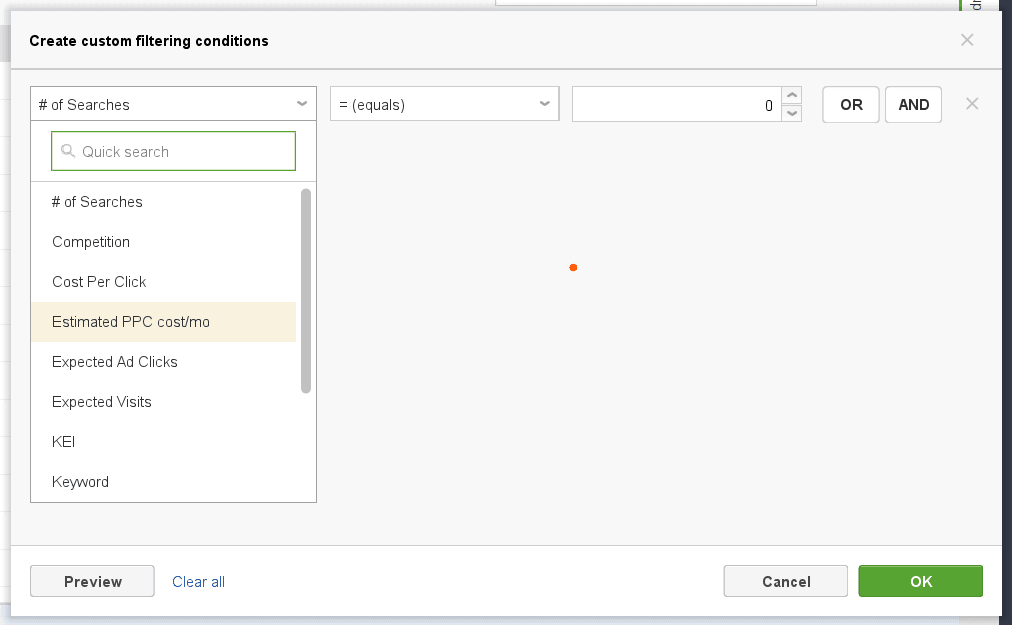
These settings allow you to narrow your research to more refined keyword strategies.
Additionally, Rank Tracker integrates with Google Search Console and Google Analytics 4, allowing you to pull keyword data from these sources.
One core feature is support for other search engines, like Yahoo, Yandex, Bing, YouTube, Ask, and Amazon. This is a helpful feature if you optimize for search engines other than Google.
Depending on the research method you use, you can choose desktop or mobile results, SERP features, domain or subdomain URLs, language, and the number of top-ranking pages.
The keyword sandbox is where you store keywords for later use. Think of it like the Semrush keyword manager but with fewer features and capabilities.
While the SERP Analysis feature in Rank Tracker isn’t typical in keyword research, it lets you analyze correlations among SEO metrics across competitors’ organic ranking pages for a particular keyword.

This feature supports predictive SEO research and competitive analysis based on organic search results.
Final Verdict – Keyword Tools
This is a close battle.
Both SEO platforms give you advanced keyword tools for effective keyword strategy campaigns. You can perform in-depth keyword analysis using either Rank Tracker or Semrush.
However, accuracy and access to in-depth data are essential here, which is something Semrush offers more.
Semrush’s keyword data accuracy and access level are unmatched by Rank Tracker. This is not to say Rank Tracker is insufficient for an extensive keyword research campaign, but Semrush tends to provide more comprehensive data.
Plus, the sheer size of the Semrush keyword database puts it ahead of competitors. With 28 billion keywords in its database and still growing, only Ahrefs comes close.
Well, for this round, Semrush won again.
3. Rank Tracking
You need an accurate rank-tracking tool to measure the impact of your SEO strategies.
Both SEO Powersuite and Semrush offer advanced keyword-tracking tools.
Semrush Rank/Position Tracking
Semrush’s position tracking is a comprehensive tool that lets you view data on keyword positions, traffic, and visibility. Also, it compares your performance with competitors.

There is a lot of data to review within Semrush’s keyword tracking tool; you can:
You can dive deep into each report for more keyword insights, or check the Overview tab to see your progress.
With these comprehensive keyword reports, you can analyze performance, track your progress everywhere, and make the right decisions.
Semrush automatically updates the report, so you always get the latest info on your keyword rankings. You can also set up email notifications for keyword position changes.
SEO PowerSuite Rank Tracking
Once again, Rank Tracker comes in and delivers strong performance. It is SEO PowerSuite’s keyword position-tracking tool.
To start, you can track keywords in over 597 search engines on mobile and desktop devices, and track location keywords, etc.
This is one of Rank Tracker’s notable features: it lets you choose or customize the search engines and locations you track to measure keyword performance.
You can also track competitors’ keyword performance and compare your progress. Like Semrush, you can see keyword visibility, track PPC keywords, and match keywords to their respective ranking URLs.
You can also view historical keyword data to track progress and see whether your keyword strategies are working.
This report also includes keyword position distribution, which shows how your keywords are spread across the top 100 ranking positions.

Another helpful feature is the task scheduler. Here, you can schedule tasks to run automatically.
For instance, you can set up automatic keyword report updates, tell Rank Tracker to publish reports to clients or have them email you at a specific time.

This can save you time and effort, which you can put back into running other aspects of your business.
Final Verdict – Rank Tracking
No doubt, Rank Tracker gives you all the essential features you need to track keyword position and visibility in most search engines.
You can track more locations, search engines, and platforms than you can in Semrush.
However, Semrush offers more features and tools, making it easier to dive deep into keyword position and performance data.
So, the winner depends on your preferences and needs.
Rank Tracker is the ideal keyword tool for tracking more than just Google search across all locations. If Google search engines are your main priority, Semrush is sufficient.
4. Off-Page SEO
Semrush and SEO PowerSuite give it all here.
The battle for off-page SEO is hard to decide between the two tools.
Let’s see how Semrush vs. SEO PowerSuite lets you do off-page SEO within their platform.
Semrush Off-Page SEO Tools
Semrush’s backlink tools enable you to analyze, audit, build, and compare link profiles with competitors.
You can analyze your link profiles, audit backlinks to remove or disavow bad ones, research prospects, follow up, and see how your competitors are doing.

You can dig into lots of metrics and data to find good links, track new and lost links, analyze referring domains, etc. In summary, you can do the following:
In addition, you can bulk-analyze up to 200 URLs. This is a helpful feature for SEO agencies and link builders.
Also, Semrush integrates with Google Search Console and Analytics to collect link data for further analysis.
Within your account, you can connect a mailbox, allowing Semrush to send emails to prospects on your behalf. Together with custom outreach strategies, Semrush lets you find link partners using 8 different strategies.

Semrush’s network graph is one of the highlights of its Backlink Analytics tool.

The network graph lets you quickly tell whether your analyzed website has a good backlink profile. The more green dots you have in the chart, the better. Red dots signify potentially harmful links from a possibly questionable website with shady link-building practices.
Also, Semrush lets you upload CSV files containing link data from other tools. You can import link data into Semrush and compare link metrics with those from other SEO tools.
SEO Powersuite Off-Page SEO Tools
For off-page SEO, you need two tools within SEO Powersuite: SEO Spyglass and Link-Assistant.
SEO Spyglass, an SEO Powersuite backlink checker, offers many features for conducting proper backlink analysis, audits, and link management.
In the summary view, you can quickly see new/lost links, check link history, the number of referring domains, the anchor text cloud, the total number of links, the first-seen date, etc.

Like Semrush, SEO Spyglass lets you compare competitors’ link profiles, analyze potential link penalties, assess link SEO value, and evaluate links using similar metrics.
For example, you can analyze links based on the following criteria:
If you’re a link builder or an agency, you’ll love the bulk analysis feature in SEO Spyglass. This feature lets you analyze up to 200 domains at once.

SEO Spyglass’s link insertions feature helps with competitive link analysis. With it, you can check for overlapping links with several competitors.
SEO Spyglass is essential for auditing, analyzing, and monitoring links, detecting toxic links, and tracking link growth over time.
Backlink checker tools are one part of off-page SEO; you need a link-building tool to complete your efforts.
This is where Link-Assistant comes in.
Link-Assistant lets you build backlinks backed by data and research. You can research link prospects from various methods:

With Link-Assistant, you can run link-building campaigns at massive scale without another tool. Link-Assistant allows:
You can do all of this effortlessly within the application interface.
Final Verdict
SEO Spyglass gives Semrush a run for its money here.
You can achieve most of what the Semrush backlink tools let you do with SEO Spyglass. A few exceptions are that outreach campaigns and prospect management are part of Link-Assistant features.
So, you will need SEO Spyglass and Link-Assistant to conduct full-scale backlink analysis and link-building campaigns.
Also, Semrush historical data goes back to 2013, while SEO Spyglass shows only the last 12 months.
Aside from that, off-page SEO is a tie between SEO Powersuite and Semrush. Both tools give you everything you need to build your website’s link profile.
However, if checking link history for more than a year will improve your link-building strategies, consider Semrush; otherwise, both tools can run link-building campaigns effectively.
5. SEO Reporting
For SEO agencies, freelancers, and small businesses, SEO reporting capabilities are one of the features that make the difference.
For SEO reporting, both Semrush and SEO PowerSuite offer the tools you need to create, manage, and deliver customized SEO reports your clients will love.
Both offer prebuilt templates to get you started, and if you don’t want those, you can customize report metrics to fit your specific SEO needs.
While SEO Powersuite requires you to click SEO metrics into the report, Semrush lets you drag and drop SEO metrics into the report. Both systems are beginner-friendly, easy to handle, and convenient.
You can also create white-label SEO reports, though access depends on your plan’s limitations.
Sending your report is relatively easy, too.
The report can be delivered via email, PDF, or print. You can also schedule or automate specific SEO reports for clients on a certain date, at intervals, or at whatever time you choose.
Final Verdict – SEO Reporting.
There is no right or wrong choice here. Your choice depends on your preferences and unique SEO needs.
Indeed, it’s a tie.
6. Pricing
This is where things get complicated, and you need to think it through before choosing.
First, before deciding which SEO tools to purchase, review the features and tools and choose them based on your SEO needs and business requirements.
Semrush has monthly subscription plans, while SEO Powersuite is billed annually. SEO Powersuite also offers 1-, 2-, and 3-year license plans. This means you can purchase multiple-year licenses at a lower price.
Here is a comparison between SEO Powersuite and Semrush pricing plans.
| SEO Powersuite | Semrush |
|---|---|
| Forever Free License | 7-Day Free Trials |
| Professional License $299/yr (1-year plan) | Pro $129.95 per month |
| Enterprise License $499/yr (1-year plan) | Guru $249/95 per month |
| Business $499.95 per month |
Note: If you subscribe to the SEO PowerSuite multiple-year license, you get a lower price than in the table above.
The two-year plan gives you a 20% discount, while a 3-year plan saves you 34%.
You don’t have to buy an SEO tool before you know how it fits your SEO strategy.
Here’s what I recommend: download the free plan of SEO Powersuite and use it for a while.
This lets you learn its features, limitations, and capabilities. You won’t be able to access all features or get in-depth SEO data, but it’s enough to help you decide.
In the free plan, project saving is disabled, and access to in-depth SEO data is limited in every report you run.
However, you can purchase the application separately if you only need specific SEO features, like Rank Tracker for keyword research. But you will save more money by getting the bundle kit.
Regarding Semrush, sign up for the free trial and explore the platform. You can access premium features, optimize your web pages, and see how the software can help you grow.
If you don’t want to try any of these tools for another reason, you can check out my SE Ranking vs SEO Powersuite comparison or Semrush vs SE Ranking.
Alternatively, check the list of top SEO tools in the market today.
FAQs
How effective are SEO Powersuite and Semrush in identifying low-competition keywords with high search volume?
Semrush generally excels at finding low-competition keywords with decent search volume thanks to its extensive database and filtering options. But that doesn’t mean SEO PowerSuite isn’t doing a good job of finding low-competition keywords; Semrush just seems to be ahead in that area.
Can SEO PowerSuite or Semrush help me analyze my competitors’ backlink profiles and identify link-building opportunities?
Both tools provide in-depth backlink analysis, but Semrush typically offers more data points and advanced filtering options. You can use both tools to perform a comprehensive backlink analysis and uncover your competitors’ link profiles and strategies.
Which tool provides better data on keyword difficulty and search intent?
Semrush often provides more detailed data on keyword difficulty and search intent, including related keywords and SERP analysis. SEO Powersuite also provides data on keyword difficulty, related search phrases, and SERP features, but it doesn’t include search intent data. However, you can perform unlimited keyword research with SEO Powersuite (even on the free plan), which isn’t possible with Semrush.
How do SEO Powersuite and Semrush compare in terms of tracking keyword rankings over time?
Semrush and SEO Powersuite offer rank tracking and keyword management, but Semrush provides more comprehensive data, including historical trends and competitor rankings.
Which is better for small businesses and freelancers based on pricing?
Regarding pricing, SEO Powersuite is more affordable and better suited to small businesses and freelancers than Semrush. Semrush is highly priced, though it often offers more tools and data points than SEO Powersuite.
Conclusion – SEO Powersuite vs Semrush
When comparing Semrush and SEO Powersuite, Semrush is the better SEO tool.
Semrush shines across most aspects of SEO, including keyword research, competitive analysis, backlink analysis, and content optimization. It is a powerful platform for serious SEO professionals.
However, SEO Powersuite offers many excellent features to handle your SEO tasks. You won’t be short on tools or SEO data, especially if you’re looking to use essential SEO functions.
The main differences between Semrush and SEO Powersuite are the depth of SEO data, accuracy, and the features and tools available on each platform.
Semrush consistently expands its toolset across industries, platforms, and marketing needs.
With Semrush, you can handle all digital marketing tasks and feel confident in its capabilities and features.
While SEO Powersuite is an SEO tool first and foremost, its other functions are secondary.
So, which SEO tool is suitable for you? SEO Powersuite or Semrush?


“Fantastic comparison! This article offers a detailed insight into SEO Powersuite and Semrush. It’s immensely helpful for those navigating the SEO landscape, providing clarity on the best tool choice.”
Glad you find it helpful, David. Thanks.
It is interesting comparison, but I have used SMERush for my overall digital marketing journey. So I voted SEMRush.
Thanks for sharing your opinion.
Great comparison. This comparison between semrush and SEO Powersuite is insightful and resourceful. Thanks for providing such a well researched comparison.
Thank you for presenting a thorough comparison between SEO PowerSuite and SEMrush! As a digital marketer constantly seeking ways to optimize website performance and enhance SEO strategies, I find this analysis incredibly valuable.
Glad you find it helpful.
Excellent analogy! Semrush and SEO Powersuite are explained in depth in this post. For people who are unfamiliar with SEO, it’s really beneficial as it offers guidance on selecting the appropriate tool.