

Getting traffic to your blog in 2026 is a different game from what it was even two years ago.
Google’s Helpful Content Updates wiped out thousands of blogs overnight. AI Overviews now answer queries directly on the search results page, cutting organic click-through rates on informational keywords by as much as 30–40%.
And with zero-click searches becoming the norm, ranking on page one no longer guarantees the traffic it once did.
That’s the reality. But here’s what hasn’t changed: blogs that drive consistent, compounding traffic still exist. And they share one thing in common. They don’t rely on a single source.
The bloggers winning right now treat traffic like an investment portfolio. SEO is their long-term growth engine — building topical authority, targeting high-intent keywords, and earning backlinks.
But they’re also building audiences on social platforms, growing email lists, showing up in communities, and occasionally putting paid ads behind their best content.
When Google shifts its algorithms, the blogger’s traffic doesn’t collapse.
This guide covers both tracks — 15 proven strategies for driving blog traffic in 2026, split between SEO-driven and non-SEO channels.
Every tactic on this list reflects how traffic actually works today, not five years ago.
If you’re starting from scratch, start with Part 1 and build your SEO foundation first. If you’ve already got content ranking but want to reduce your dependence on Google, jump straight to Part 2.
Either way, let’s get into it.
Part 1 — SEO Traffic Strategies
Search engine traffic is still the highest-quality traffic a blog can get. It’s intent-driven, it compounds over time, and once a page ranks, it works for you around the clock without ongoing spend.
But the way you earn it has changed significantly. And here’s what’s actually moving the needle in 2026.
1. Build Topical Authority Before Chasing Keywords
The biggest shift in how Google evaluates content over the last two years isn’t about individual keywords — it’s about topical depth.
Google now rewards sites that demonstrate comprehensive expertise on a subject over sites that publish one-off articles targeting popular keywords.
If you write a single post on “best WordPress hosting” but your site has no other hosting-related content, Google has no reason to trust you as an authority on that topic.
But if you have a hosting comparison, individual hosting reviews, a speed test breakdown, and a beginner’s guide to choosing hosting — all internally linked — you’ve built a content cluster that signals genuine expertise.
The practical approach is to pick three to five core topics your blog owns and publish content that covers every angle of each topic. From beginner questions to advanced tactics.
This is called a content cluster or pillar strategy, and it’s the foundation of how sites that survived the Helpful Content Updates were structured.
Before writing your next new post, ask:
2. Match Search Intent — Not Just Keywords
You can rank for a keyword and still get zero traffic if your content doesn’t match what the searcher actually wants.
Search intent is the why behind a query, and Google has gotten extremely good at reading it.
A search for “best AI writing tools” expects a comparison listicle with options, pros, cons, and pricing.
If your page delivers a 2,000-word essay on how AI writing works philosophically, it won’t rank, no matter how well-optimized it is.
Before writing any post, look at the current page-one search results for your target keyword and ask four questions:
Your content needs to match what’s already winning, then outperform it in depth, freshness, and first-hand experience.
3. Target Long-Tail, High-Intent Keywords First
Broad, high-volume keywords like “increase blog traffic” or “SEO tips” are dominated by high-authority domains such as Backlinko, HubSpot, Neil Patel, and Ahrefs.
For most independent blogs, going head-to-head on those terms is a losing battle in the short term.
What works faster is targeting long-tail keywords — more specific, lower-competition queries with sharper searcher intent. These terms convert better, rank faster, and often have higher commercial value despite lower search volume.
Examples of the shift in thinking:
| Instead of | Target this |
|---|---|
| “keyword research” | “keyword research for affiliate blogs” |
| “build backlinks” | “How to get backlinks without guest posting” |
| “increase traffic” | “How to increase blog traffic without social media” |
Tools like Ahrefs, SE Ranking, and Google Search Console’s Search results report are your best sources for finding these gaps.
In GSC specifically, look for keywords you already rank on page 2 or 3 (10 – 30 position) for — those are your fastest wins. A content update and a few internal links can push them to page one without writing a new post from scratch.
4. Update Existing Content Before Publishing New Posts
One of the most underused traffic strategies for established blogs is refreshing old content, and it consistently outperforms publishing new posts for blogs with existing archives.
Google tracks freshness signals. A post last updated in 2021, competing against a post updated in February 2026, is at a structural disadvantage, even if the older post once ranked well.
More importantly, outdated content often fails E-E-A-T checks — outdated stats, dead links, missing current context — all of which suppress rankings.
The update process that works:
For most established blogs, this process will move the traffic needle faster than any new content strategy.
5. Earn Backlinks Through Digital PR and Original Data
Backlinks remain one of Google’s strongest ranking signals, but the tactics that earn quality links have shifted.
Cold email outreach for guest posts has become less effective. Broken link building still works, but requires scale to produce results.
What’s consistently working in 2026 is digital PR: creating content that journalists, bloggers, and industry sites naturally want to reference.
The most reliable formats for earning organic backlinks:
Original research and data: if you run a survey, publish a case study with real numbers, or compile stats that don’t exist elsewhere, other writers will cite you.
Every time someone publishes “how to increase blog traffic,” they need data to back up their points. If your site is the source of that data, you earn the link.
Contrarian or counter-narrative content: posts that challenge widely accepted advice tend to attract links and discussion. “Why publishing frequency doesn’t actually grow your website traffic” earns more links than “how to publish more consistently.”
Free tools and resources: calculators, checklists, templates, and swipe files attract backlinks passively because other bloggers link to useful resources as recommendations.
Unlinked brand mentions: Use tools like Ahrefs Alerts or Google Alerts to track when your blog is mentioned without a link.
A simple, friendly outreach email asking to add the link converts surprisingly well because the writer already chose to reference you.
6. Optimize Title Tags and Meta Descriptions for Click-Through Rate
Ranking on page one is only half the battle. If your title doesn’t earn the click, the position is worthless.
CTR is a traffic lever that many bloggers ignore completely. They optimize for rankings, then wonder why a page at position 4 gets 0.3% CTR.
The fix is to treat your title tag like an ad copy: it needs to communicate a specific benefit, create curiosity or urgency, and stand out from the other nine results on the page.
Patterns that consistently outperform in blog content SERPs:
For meta descriptions, write them as a pitch, not a summary. Lead with the outcome the reader gets, not what the post contains.
For example, “Learn five strategies to increase website traffic” is a summary, while “Five tactics that moved our traffic from 2K to 18K monthly visits — and one that did most of the work” is a pitch.
Use your GSC performance data to identify pages with high impressions and low CTR — those are your testing priorities.
A title tag rewrite on a page ranked 5th with a 0.5% CTR can double your traffic from that page without touching the content or building a single link.
7. Optimize for SERP Features — Featured Snippets, PAA, and AI Overviews
The traditional blue link is no longer the only way to get traffic from Google. Featured snippets, People Also Ask boxes, and now AI Overviews are all capturing click share, and they’re all rankable if your content is structured correctly.

Featured snippets are triggered by question-based queries. The format Google prefers is a direct, concise answer (40–60 words) in a paragraph immediately following an H2 that mirrors the question.
If you want to rank for “how to increase blog traffic fast,” your post should have an H2 that asks or echoes that question, followed by a tight, direct answer before expanding into detail.
People Also Ask boxes are an opportunity to rank for multiple related questions within a single post.
Use tools like AlsoAsked or the PAA boxes in live SERPs to identify the questions people ask around your target keyword, then add those questions as H3 subheadings with concise answers.
This gives Google signals to pull your content into PAA results, which appear above and below the traditional rankings.
AI Overviews are the newest priority. Google’s AI pulls structured, authoritative content into its Overview panel, and while these reduce clicks for informational queries, being cited as a source still drives brand visibility and some traffic.
To increase your chances of being cited: use clear heading structures, include original first-hand perspective, cite credible data, and write in a direct, factual tone.
Fluffy, opinion-heavy content rarely makes it into AI Overviews. E-E-A-T-aligned, structured content almost always does.
Part 2 — Non-SEO Traffic Strategies
SEO builds the foundation, but it’s slow and increasingly unpredictable. The blogs with the most resilient traffic in 2026 don’t wait for Google. They’ve built direct marketing pipelines to their audience through channels they have more control over.
This is traffic Google can’t take away.
8. Build an Email List — Your Only Truly Owned Audience
Every other traffic channel on this list is rented.
Your email list is the one audience channel where you control the relationship entirely.
If you have 5,000 engaged email subscribers, you can generate meaningful, predictable traffic to every new post you publish — independent of where you rank or how the algorithm shifts that week.
That’s a fundamentally different traffic model from one built entirely on SEO.
The basics that work in 2026:
Lead magnets still convert, but generic “subscribe to my newsletter” prompts don’t.
Offer something specific and immediately useful: a checklist, a swipe file, a mini-course, a template, or a resource list tied directly to your niche. The more specific the offer, the higher the conversion rate.
In-content opt-ins outperform sidebar widgets. Place your lead magnet offer in your highest-traffic posts, contextual to what the reader just consumed.
A reader finishing your “how to start a blog” guide is primed to opt in for a “blog launch checklist.”
Welcome sequences drive return visits. Don’t just collect emails and batch-send blog updates.
A three-to-five email welcome sequence that delivers value immediately conditions subscribers to open your emails and click through to your content.
The goal isn’t a large list; it’s an engaged one. 2,000 subscribers who open your emails and click your links are worth more than 20,000 who don’t.
9. Use Short-Form Video to Drive Blog Traffic
Short-form video has the highest organic reach on any platform right now, and many bloggers aren’t using it to drive blog traffic because they treat it as a separate content channel rather than a distribution tool.

The approach that works is repurposing blog content into short video formats rather than creating original video content from scratch.
Take your best-performing post, extract the three most valuable points, and film a 30–60-second vertical video that delivers those points directly. End with a clear CTA: “Full guide in the link in bio” or “I wrote a 2,000-word breakdown — link in bio.”
Where this works in 2026:
YouTube Shorts: Google indexes Shorts in regular search results. A Short on “how to increase blog traffic” can appear in Google search and drive clicks to your full post. It’s one of the few short-form formats with built-in SEO crossover.
Instagram Reels: strong discovery reach for lifestyle, marketing, and business content. The link-in-bio model works if your CTA is specific enough.
TikTok: highest organic reach ceiling, but less reliable for driving external traffic due to platform friction around links. Best for brand awareness and list building rather than direct click-through.
LinkedIn: significantly underused by bloggers. LinkedIn’s native video format has strong organic reach for professional, B2B, and career-adjacent content.
A 60-second LinkedIn video on a marketing or blogging tip with a link to the full post in the comments consistently outperforms text-only posts.
You don’t need to be on all four. Pick the platform where your audience already spends time and go deep on one before expanding.
10. Drive Traffic from Reddit and Online Communities
Reddit is one of the most underused blog traffic sources, and it’s become significantly more powerful since Google began prominently featuring Reddit threads in search results.

Being active in the right subreddits puts your content in front of highly engaged, niche-specific audiences and increasingly in front of Google searchers, too.
PRO TIP!
The rules are non-negotiable: Reddit has zero tolerance for self-promotion disguised as contribution.
The approach that works is to build a genuine community presence first by answering questions thoroughly, sharing opinions, contributing to discussions, and linking to your content only when it’s directly relevant and genuinely the best resource for that specific question.
Subreddits worth targeting for blogging and marketing content: r/blogging, r/SEO, r/juststart, r/Entrepreneur, r/digitalnomad, r/sidehustle, and any niche-specific subreddits relevant to your content topics.
Quora follows a similar model. You answer questions thoroughly and link to your blog post as a “read more” resource when relevant.

Quora answers rank well in Google for long-tail informational queries, so a well-written answer with a contextual link to your post can drive both direct Quora traffic and indirect SEO traffic over time.
Facebook Groups and niche online communities (Skool, Discord, Slack) work for referral traffic in the same way. Contribute first, and share your content when it’s genuinely the most helpful resource for a specific question.
11. Paid Traffic — Amplify What’s Already Working
Paid traffic has a bad reputation among bloggers because many people run it the wrong way. They spend money sending cold traffic to blog posts and wonder why the ROI is negative.
Paid traffic works when it amplifies content that’s already proven to convert, or when you use it to build an owned audience (email list) rather than just buying pageviews.
The two smart paid traffic approaches for bloggers in 2026:
Facebook and Instagram Ads for list building: run a low-budget campaign ($5–$10/day) promoting a specific lead magnet to a targeted audience.
You’re not paying for traffic to a post: you’re paying to grow an asset (your email list) that drives traffic to every future post for free. This is a fundamentally better ROI model than boosting blog posts directly.
Retargeting warm audiences: if you have the Meta Pixel installed, you can retarget people who’ve already visited your blog with ads promoting your newest content or lead magnet.
This audience already knows you, so conversion rates are significantly higher than cold traffic. Even a small budget ($3–$5/day) can keep your content in front of past visitors consistently.
Pinterest Ads are worth testing: for bloggers in visual niches (food, home, travel, personal finance, DIY), Pinterest users are in a high-intent discovery mindset, and promoted pins blend natively into organic content in a way Facebook ads don’t.

The rule: only run paid traffic to content with a clear conversion goal — email opt-in, product sale, or affiliate click. Paying to send people to an informational post with no conversion path is a budget drain, not a traffic strategy.
12. Guest Posting for Referral Traffic and Authority
Guest posting is often dismissed as an outdated link-building tactic, but when used correctly, it’s still one of the most effective ways to drive referral traffic and build domain authority simultaneously.
However, guest posting for links alone is a low-ROI activity because most editorial links are nofollowed and Google has gotten better at devaluing manipulative link schemes.
Guest posting for audience access is a different equation entirely.
A well-placed guest post on a blog with 50,000 monthly readers in your niche can send hundreds of targeted visitors to your site in a single day — readers who are already interested in exactly what you write about.
That traffic converts to email subscribers, social followers, and return visitors at a much higher rate than cold organic traffic.
What makes a guest post drive real traffic in 2026:
One strong guest post on the right site is worth more than ten average ones on sites with no real audience.
13. Repurpose Content Across Platforms Systematically
The biggest traffic unlock for most bloggers isn’t creating more content; it’s getting more mileage out of what they’ve already created.
A single well-researched blog post contains enough material for five tweets, a LinkedIn post, a short-form video, a newsletter section, and a Quora answer, each of which drives traffic back to the original post.
This is content repurposing, and the bloggers who do it consistently multiply their distribution without multiplying their content production effort.
A practical repurposing stack for one blog post:
The goal isn’t to be everywhere; it’s to systematically extract more distribution from every piece of content you invest time creating.
14. Collaborate With Other Creators in Your Niche
Co-created content and creator collaborations are among the fastest-growing traffic strategies in the creator economy. Yet most bloggers overlook them because they view other bloggers as competitors rather than marketing partners.
The formats that work:
Expert roundups: invite 10–15 bloggers in your niche to answer one specific question, then publish the roundup. Every contributor has an incentive to share it with their audience because their name is attached to it.
One roundup post can generate significant social shares, backlinks, and traffic from audiences you’d never have reached on your own.
Podcast guest appearances: Most podcast hosts allow guests to share a link to a resource in the show notes.
A single appearance on a mid-sized podcast in your niche can drive a sustained trickle of warm, engaged traffic for months after the episode airs.
Listeners who seek out your content after a podcast episode are among the most engaged visitors your blog will ever receive.
Newsletter swaps and cross-promotions: if you have an email list, find bloggers in relevant niches with similar list sizes and propose a simple cross-promotion: you mention their newsletter to your subscribers, they mention yours to theirs.
This is one of the fastest ways to grow an email list with warm, relevant subscribers.
Joint content projects: co-authoring a guide, creating a shared resource, or running a joint webinar with another creator in your space can immediately double your distribution reach because both audiences see the content.
The underlying principle across all four formats: you’re borrowing trust.
When someone your audience already follows says, “read this,” the conversion rate is significantly higher than any cold outreach or paid promotion.
Part 3 — On-Site Traffic Amplification
The first two parts cover how to attract traffic from outside your blog. This section is about what happens once visitors arrive, and how your site structure either multiplies that traffic or leaks it.
15. Analyze Your Best Content and Double Down
Many bloggers spend 90% of their time creating new content and almost no time studying what’s already working. That’s backwards, especially for a blog with an existing archive.
Your best-performing posts are already telling you exactly what your audience wants, what Google trusts you to rank for, and where your topical authority is strongest. The job is to read those signals and act on them.
Start in Google Search Console. Pull your top pages by clicks over the last three months. Look for three things:
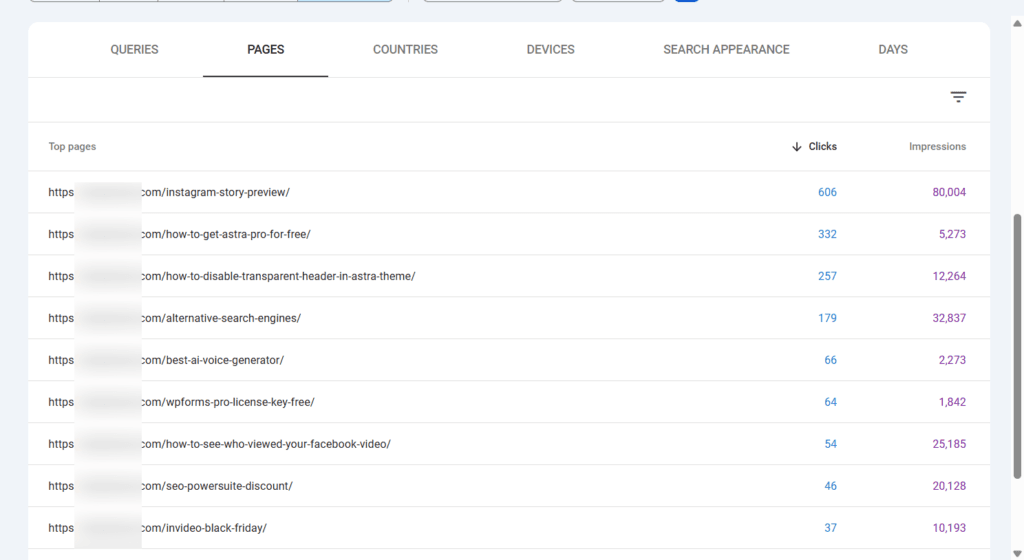
First, which posts are generating the most clicks? Those are your traffic anchors. Every new post you publish in that topic cluster should link back to them, and they should be updated regularly to stay fresh and comprehensive.
Second, which posts have high impressions but low clicks? Those are ranking but not converting. That’s a title tag and meta description problem, not a content problem.
Fix the content preview, not the post.
Third, which posts rank for keywords in positions 4–15 with meaningful impressions? Those are your fastest wins.
A content update, a stronger internal linking push, and a title refresh can move those pages into the top three, often within weeks.
Then go to Google Analytics. Look at your top pages by sessions and cross-reference with engagement metrics – time on page, scroll depth, bounce rate.

A high-traffic but low-engagement page is either attracting the wrong audience (keyword mismatch) or failing to hold attention (content-quality problem). Both are fixable, but you need the data to know which one it is.
Use what you learn to guide your content calendar.
If posts about SEO tools consistently outperform posts about blogging tips, publish more SEO tool content. If comparison posts drive more affiliate clicks than how-to guides, write more comparisons.
Let the data tell you what to produce more of; don’t guess.
This single habit — reviewing performance data monthly and letting it shape your next month’s content decisions — compounds over time in a way that no single tactic can replicate.
Conclusion
Increasing blog traffic in 2026 requires a different mindset than it did even a few years ago. The bloggers who are growing aren’t chasing a single algorithm or doubling down on one channel; they’re building multiple traffic streams that reinforce each other.
SEO builds your long-term foundation. Email gives you an audience you own. Short-form video extends your reach. Community participation builds trust. Paid traffic amplifies what already works.
And consistently studying your own data ensures you’re doubling down on what’s actually driving results, not just what feels productive.
Pick two or three strategies from this guide that match where you are right now. Execute them consistently for 90 days before evaluating.



Bringing traffic to a new blog is really challenging these days. I think content writing is still the key and after that one can look for guest posting, blogger out reach, participating in round ups to take the blog authority to next level. Then only gradually traffic will improve. many thanks for this simple but effective share.
Hey Adeshokan,
Every blogger is striving to get more and more visitors to his/her blog. It’s always important to have the quality content.
You can embrace it with the catchy headlines and spreading it to your targeted audience. I like the way you have shown the concept of visual content.
Thanks for sharing with us.
~Ravi
Hello Shamsudeen, thanks for this great post.
Building traffic sources is a job for every blogger.
Traffic is best enjoyed when it flows steadily to a blog than when it oscillates.
Have a nice day, I will check back on your blog!!
Nice post bro!
Traffic is one big problem for every newbie blogger.
As you said, goof and fresh content helps to get good amount of traffic in short period.
I always believe; content is king. Another way to get a goof amount of traffic is by commenting on top blogs.
Have a nice day, Adeshokan
thanx for sharing this informative content.
You’re always welcome, Cristina.
This a nice one, but down here in Nigeria, where everyone is only tailoered to the entertainment industry then bringing traffic to your blog is like passing through the needles eye when right now in Nigeria everyone is a blogger. But i still think taking time to do what is different and the publishing and sharing this would be a wonderful tactic..
Thanks for the post once again
Hi Mike,
You’re right on that, a good percentage of bloggers in Nigeria are into entertainment niche to the point people taught a blog is meant for breaking news and gossip. And that bring along competition in that industry.
Well, I believe if you can come up with something unique, relevant to the society and produce useful information regularly, you stand a great a chance to rise above the average.
Thank you.
Great tips. To me creating viral content is the best.
Thanks Kevin, nice having you here
Great post Adeshokan! I have found that making list works the best for me. Taking the time to make a list can always bring you some good traffic and some links as well if its useful.
Hi David,
List posts are great both for the author and the readers as well, thanks for coming.
Very informative and helpful post thanks…
Talking about Backlink Mr. Shamsudeen, how many of them is required to be on the first page of Google for a medium competitive phrase?
There are no specific number needed to rank for any keyword, is all about the quality of the links and lots more other factors that contributes to ranking.
User intent, page context, topic relevancy, keyword usage, etc. and many of the times – blog/author authority on the subject matters.
Talking about how many links require, install the MOZBar for Google chrome on your browser and turn it on. Next time you run a search or browse through a web page, this little tool will let you see through the page back-link profile so you know how to analyze your chances of beating your competitors in SERP.
Hope this help..?
Yeah… Am grateful!
Very nice article,Traffic is very important issue now a days.
Thank you
Valuable content shared.Traffic problem is the first thing all should keep in mind.Thank you for sharing.
Hi Mahesh,
Glad you find the information useful, let me know if it work for you. Thanks.
Great stuff, Thank you for sharing such a wonderful post.it will be very useful.
Hi adeshokan,
What an insightful post!
I love the part where you said”… No need to re-invent the wheel” > This statement aptly captures my philosophy about Internet marketing.
Why Reinvent the wheel?
It is becoming increasingly difficult to drive traffic to the blogs. And my strategy is simple:
Look at what other successful blogs are doing, analyze it, personalize and implement.
I recently published a research on the the social strategy of selected tech blogs to drive traffic. visit the blog to read.
Thanks for sharing and I will share this with my twitter followers.
Regards
samsteve
Hi Steve,
Thanks for your awesome comment.
With lots of businesses starting up online, the fight for attention is on the rise. Executing what already works for others is a sure strategy to beat the competitors.
Thanks for your time, Steve.
Hi Adeshokan,
Few days before I started a blogging with affiliate marketing; I am totally failed to get a more traffic on my blog. But finally today I read your post and note down few points to improve my blog.
I failed to reach out my audience because of my title of post. You wrote a informative and easy to understand article… Thank you for sharing the valuable information. )
Hi Akshay,
Good to read you find some useful website traffic tactics you can try from reading this post. Let me know how it works for you.
Thanks .
Great post Cybernaira.
Unfortunately, driving traffic seems to be one of the highest hurdles to climb in one’s online business endeavour. I think your research on this issue speaks volume. Nice post sir.
Insightful posts…thanks bro
Glad you like it, Danny.
it is the dream of every blogger to attract audience to his blog. And here you are given us the teaching we could have paid for.
Thanks for sharing.
Very Informative post. It has motivated me to start blogging again. Thank you for taking the time to write this.
Hi Alena,
Glad you find it useful. Thanks for your time here.
Love this post! I’m just starting out and this has some great tips and insight, thanks!
Thank you for providing these details.
Glad you like it, Daniel.