

There are no BIG numbers here. However, I learned many SEO lessons, which I want to share today. If you want to improve organic search traffic in a considerable amount of time, give me your attention.
I promise you won’t get bored with fancy SEO theories that lead to nowhere. These are practical SEO tactics I explored during the COVID-19 lockdown. While we were on the lockdown, I took the time to work on some SEO tips. The results are not too bad.
The reality of search engine optimization is this:
While we want to see the result moving up quickly, it takes time before search engine optimization explodes.
However, the good thing is that you can tell if your SEO strategy is working when you monitor changes in your website search traffic.
After a month of testing, changing, tweaking, and implementing several SEO tactics, I can see some small wins that tell my SEO efforts are paying off.
The good news is that I can convert this traffic into sales. This is what matters. Except you’re running a blog for fun, traffic is nothing if you can’t convert it to sales and leads.
I have included in this post a detailed guide for all the steps.
So, let’s begin…
Getting Started – Running Website Auditor
I used three SEO tools to achieve this: Google Search Console, Website Auditor, and the Rank Tracker.
And a bit of link-building activities.
I built five backlinks in April through manual email outreach to 3 individual pages.
So, this is all for it.
The first thing I did in March was to analyze the SEO status of the website.
This gives me an overview of the on-page SEO errors and what I need to fix them. The SEO tool I used to run the site audit is the SEO Powersuite Website Auditor tool.

I opened a website Audit and ran an SEO analysis of the website.
There were on-page SEO issues that needed quick attention. The blog 404 error page is not correctly set up. I had set up a customized 404 error page some years ago that I had forgotten.
This customized 404 error page is not returning a 404 error status code. But with the help of the Website Auditor, I could detect this and fix it.
Several pages with long titles and empty meta description tags must be fixed. Also, broken images and empty alt tags. Some resources are restricted from indexing.
Though these pages were intentionally de-indexed from search engines, it is still a good time to recheck.
Just in case.
I spent a couple of hours working on-page SEO optimization. After this, I ran another check through the Website Auditor to see the changes in real time.
This is one of the helpful features of the Website Auditor. You can review the changes you’ve made to your web pages in real-time.
There are two ways to recheck the changes you’ve made to your web pages. You can re-run a check on individual SEO tasks or rebuild the entire SEO report from scratch.
If you want to rebuild the entire SEO task after applying changes to your website, click on the “Rebuild Project” label on the top-right of the page. Click on the synchronize icon To rebuild an individual SEO task.

Of course, I couldn’t fix everything the Website Auditor reports as on-page SEO errors. This is because some of the on-page SEO errors were intentional and not something to worry about.
Like do-follow external links.
To learn more about each SEO factor, read the note and the SEO factors on the Website Auditor interface. This will give you an overview of how essential SEO factors are to Google search ranking.
I completed the on-page SEO factors after several hours of running SEO tasks.
The next thing I did was dive deep into the Google search console. I used the Rank Tracker from SEO Powersuite to analyze the search queries in the Google search console report.
This is because not every query search console report will be profitable for your business. Although these are search queries your web pages are getting impressions from, from experience, you won’t profit from optimizing for all these queries.
How I Drive 87.23% More Organic Traffic in 3 Months
This is where it all began to make sense to me after the on-page SEO task. Just fixing the on-page errors didn’t have any significant positive impact on website traffic.
However, after I followed the steps below to run keyword research, I gained more organic search rankings in less than three months. And even made a few affiliate sales in the process.
The good news is that you don’t have to write and publish hundreds of posts to increase organic search traffic. I achieved this with 75 blog posts published then.
And only about 20% of these posts were responsible for 99% of the blog’s organic traffic growth.
The Keyword Research Process That Works
First, after following the steps described in this post, I gained a 22.5k organic search result impression. I moved from 69.8k SERP impressions in the previous three months to 92.3k search impressions three months later.
Technically, the more search impressions your web pages receive, the more clicks.

But impressions and clicks don’t always match up. There is more to organic clicks than just getting the search impressions. A page may reach thousands of SERP impressions but no clicks.
Lots of factors contribute to a higher click-through rate from search engines. From keyword ranking position, headline copy, meta description/snippet, relevancy, user’s search intent, etc.
There is more to it.
The Google Analytics report shows an 87.23% organic search traffic increase in 3 months.

If you look closely at the screenshot above, you will notice the growth didn’t happen to the organic traffic alone. But every other traffic channel as well.
As reported by Google Analytics, there is a 19,612.50% increase in traffic from the “other” traffic channel. And a 27.54% improvement in direct traffic to the website.

Both referral and social traffic channels experience significant website traffic increases, too. Overall, the website has improved its traffic volume significantly in the last three months.

If this trend continues, I can only see the website increasing its organic traffic month after month.
Now, let’s get into detail on improving organic search traffic by doing effective keyword research. All the numbers above wouldn’t have been possible without targeting the right keywords.
How to Combine Search Console With Rank Tracker Keyword Tool
The good thing about this keyword strategy is that the Google search console has made the task easier. The search console shows you what search queries your pages are showing for.
This removes any guessing game in your keyword research process.
Traditionally, many marketers will update existing content with search console keyword data as it is. That’s probably your approach to content optimization with search console keyword data.
While this approach can take you far, optimizing and improving organic search traffic from the same keyword is better. And drive more sales while increasing SERP traffic.
Instead of directly inserting the search phrases into your content, please take it to the Rank Tracker tool and run it through the keyword research tool for even more hidden search terms.
Here is what I did – The Experiment
These search phrases are from the Google search console for some of my existing pages. The image below shows the changes in clicks and impressions from the last three months to the previous three months.

I could update the existing content for these exact keywords and drive more organic traffic.
But no, I didn’t do that.
Instead, I head over to the Rank Tracker keyword tool and plug in a search term to see how profitable, search volume, CPC, and the keyword difficulty for this keyword are.
First, I entered “SEO Powersuite free license” from one of the search queries in the search console.

From a monetary view, this is not a profitable keyword for sales and conversion. Although you will drive traffic from this keyword, it may not result in paying customers.
The keyword intent is clear. The user is probably looking for free SEO software.
If you’re optimizing to increase sales and not just increase traffic volume, the Rank Tracker is the perfect keyword tool to try.
After analyzing the targeting page related to the SEO Powersuite keyword above, I gathered more relevant keywords from the Google search console to run through RankTracker.
I analyzed the keywords’ profitability, popularity, and cost-per-click (CPC). I also checked keyword difficulty and ran these keywords through Google Trends to see their trend curve.
After conducting keyword research and analyzing the data, I updated the existing page with relevant search phrases to help build my business. I also used the link inspection tool in the Google search console to re-index the page.
Search engine traffic to the page increases, and with more search traffic comes more sales potential. This is because the page is an affiliate product review content.
The Result – More Sales Traffic
In May, the page brought in 3 affiliate sales. Up to July, it had six affiliate sales for the SEO Powersuite software.
The images below show the Avangate SEO Powersuite affiliate income dashboard. And the notification of new orders emails.
In December 2019, I had only one affiliate sale for the product. However, after completing the steps described above, the page has managed six affiliate sales for the SEO product in less than three months.
This is no BIG number, but it is an indication that something is working and worth giving more attention and resources.


I took the same approach with another affiliate product and ran its keywords through the Rank Tracker.
Next, I entered the Google search console search query “wp rocket coupon,” into the Rank Tracker keyword research tool.
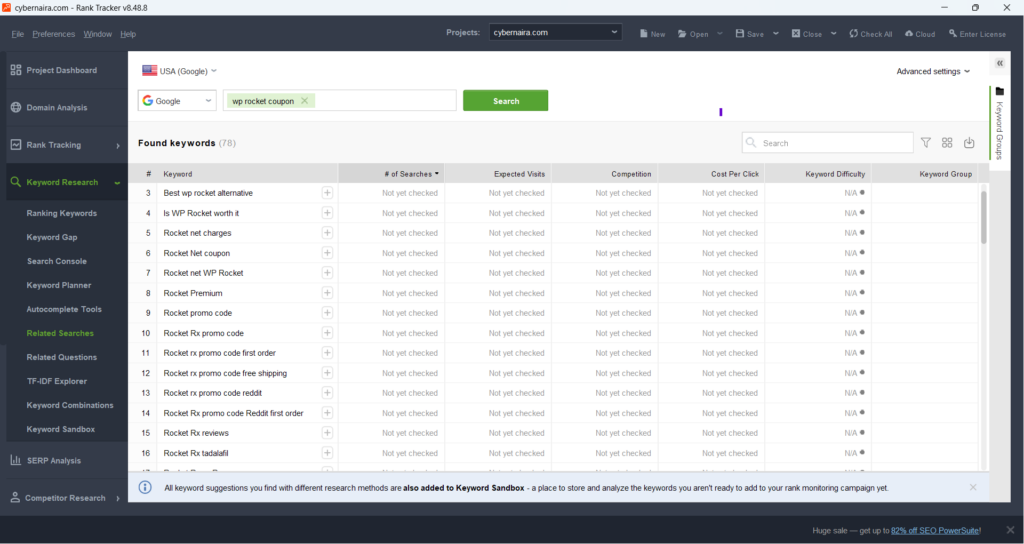
As you can see from the image above, this search phrase is worth trying. Though the search terms don’t get thousands of monthly searches, it is still a better choice, as I will reveal shortly.
After analyzing all the relevant keywords in the Google search console, I identify the most profitable search phrases.
I updated the existing pages, added more paragraphs, edited sentences, and added more relevant search terms. Like always, I got the page re-indexed by search engines.
The page received more search impressions and clicks from organic traffic. This resulted in two affiliate sales in June.

The numbers aren’t concerned here, but something works and proves positive.
Conclusions…
There are endless possibilities when it comes to keyword research.
But one thing is sure: using the right keyword tool for the task will help uncover hidden keyword data you never thought of.
If you’re optimizing to increase sales and drive more relevant website traffic, you need the right keyword research analysis tool to stay ahead of the competition.
Try SEO Powersuite for free today.
Let me know in the comment box if you have any questions about this post.




Yeah! Shamsudeen, that’s a nice post. I also tried SEO Powersuite too and it works pretty fine because I was able to know some SEO blunders that held my website from ranking.
After fixing the errors, I researched for a good keyword that was easy for me to rank for and I started getting traffics and now I have more keywords ranking in search engine.
Now I am encouraged to work hard because the result is obvious.
Many of us are not sure if their website is working or not. SEO Powersuite will help you.
Thanks Ikenna,
I’m glad to read you also find SEO Powersuite very helpful SEO tools. Thanks for your valuable input and for sharing your experience here.
Nice post. it’s helpful for me.
Hey! Shamsudeen
Looks good, having useful information it’s help me lot.
Thank you for sharing this Shamsudee.
Hey Shamsudeen,
That’s a nice post. Thanks for sharing the important details.
SEMrush is the best tool to do SEO. I use it only for competition and keyword research.
Hi Ashutosh,
Glad to read you also find SEMrush a helpful SEO tool. Thanks for reading through.
Well said, useful blog! The only problem is whenever i tr to implement all these it doesn’t works. Will try these this time. Thanks Shamsudeen!
Hi Sambit,
Let me if this works for you this time, thanks for reading through.
Thanks, this article was helpful
You provided a great piece of informaiton about Organic Search Traffic thanks
Glad you find the post useful, Habib.
Hi Shamsudeen, i also tried Website Auditor it is really working effectively but the information you shared in this post was also very large and contains all the stuffs i want, thanks for sharing the information.
Hi Ketty,
Glad to read you find something you want in this post, I’m happy to have helped in one way or the other. Thank you.
What other keyword tool can I use sir?
Hi Abubakar,
Rank Tracker is good, or you can start with the Google keyword planner. Like Google keyword planner, Rank Tracker also have a free plan. Hope this helps?
Hi Shamsudeen,
I really felt where good by reading these article we can gain more knowledge about traffic as these article was very helpful for me.
Thank you shamsudeen
Hi Kasturi,
Thanks for reading through. Good to read you again more knowledge after reading this.
See you other times.
Traffic is very important for each & every website. It is very necessary to improve organic search results. This post is very helpful. Thank you for posting.
Hi Ridzi,
Thanks for reading through, glad you liked it.
Hii,
Great blog post!
This is Awesome blog post about how to improve organic search traffic. This blog helps me to increase my website organic traffic.
Thanks a lot for posting content for free.
Thanks for sharing this insight, personally I love doing my SEO with google tools like trends.google for keyword research, and search console for my site analysis more than depending on third party.
Hi, John,
Glad to read you find this post helpful, also love the Google SEO and keyword tools mentioned here. Thanks.
A wonderful article which is very useful and if we follow these guidelines, I am sure we will rank our website higher in SERP. Thank you for publishing this blog.
This is a well detailed content for anyone who wants to grow their website
Hi, Joe,
Thanks for reading through, glad you like it.
Thanks this article is helpful