

If your business requires more information from users to complete the contact/signup forms, the WPForms conversational forms builder is what you need.
Unlike basic lead-generation forms with two fields for users to fill out (name and email address), WordPress interactive forms let you ask questions without overwhelming users.
They bring the feel of a face-to-face conversation into web form interactions. It makes it possible to ask one question at a time.
My first experience with WordPress conversational forms was on the ConvertKit website. At the time, ConvertKit used a similar web form on its affiliate questionnaire page.
Conversational forms in WPForms make page content more engaging and easier for users to complete. This boosts the form completion rate and, in turn, increases lead signups.
WPForms interactive, user-friendly forms are distraction-free landing page forms. But you can add them to your existing WordPress pages/posts, too.
Since conversational forms are still a relatively new type of web form, you may wonder what benefits they offer your business.
Do I need Conversational Web Forms?
If your contact forms require users to enter dozens of fields, you take surveys, job application forms, accidental report forms, event planning, etc…
You may benefit from WPForms conversational or smart forms.
Some of the uses or benefits of conversational smart forms are:
Your contact forms will feel engaging and more interactive than traditional basic form types. Plus, users can use their device keyboard the way they do in chat messenger apps.
And you don’t need any coding knowledge to set up WPForms conversational forms. It’s simple to put up on your blog.
With the WPForms drag-and-drop form builder, you can finish in less than 5 minutes.
How to Build an Interactive Form With WPForms Pro
The most crucial step is installing the WPForms Pro Plugin on your WordPress website.
If you don’t already have WPForms Pro installed, get it here.
After installing and activating WPForms Pro on your website, activate the Conversational Forms add-on to make this work.
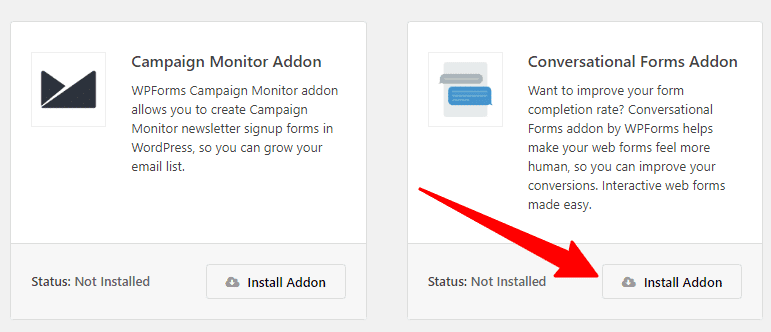
You’ll need the WPForms Conversational Forms add-on for this process to work.
WPForms add-ons are what bring more functionality and personalization to your contact forms.
Now that WPForms Pro is installed on your blog, follow the steps below to have WPForms conversational forms active.
Note: I wrote a detailed review of WPForms Pro on this page. If you want to learn more about the features and benefits of using WPForms Pro to grow your business.
Step 1. Create a “Simple Contact Form”
Hover your mouse over WPForms in the WordPress admin sidebar to do this. Click on “Add New” from the menus.

It will open up the WPForms templates setup page.
On this page, choose the simple contact form templates and give your form a name.
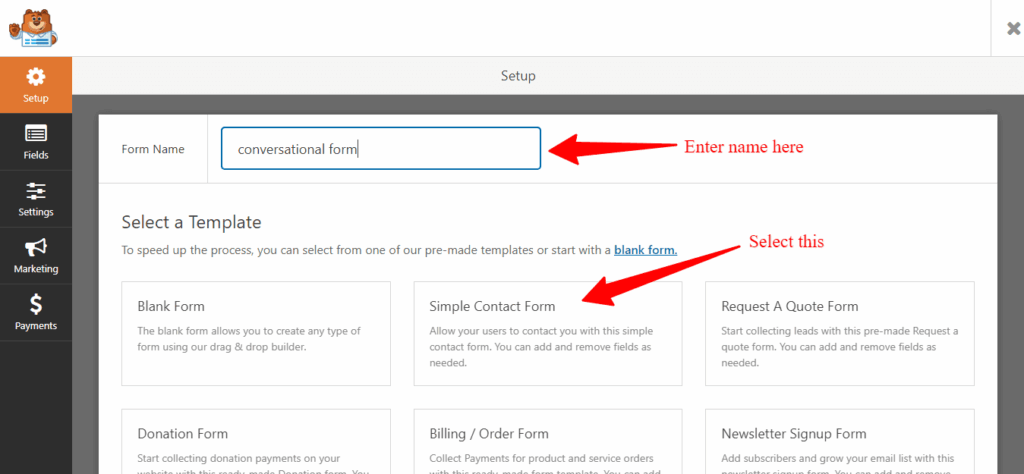
A simple contact form will now be auto-generated for you on the next page that comes up.
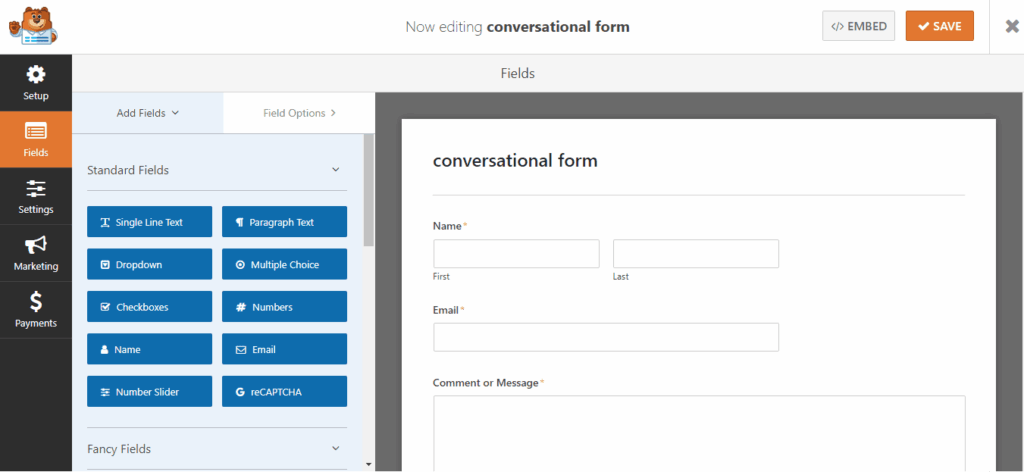
Now, we’re done with the first step. Now it’s time to move into the second phase and customize your WordPress conversational form.
Step 2. Customizing Your Conversational Form.
Your simple contact form comes by default with 3 fields in this order:
Since this is a conversational or interactive form, you probably need many other field options. So, from the left-side panel, drag any user field you want onto the Conversational form builder panel.

Add as many fields as possible if you want. Deleting a field is also simple.
Please hover your mouse over the corresponding field and click the delete icon.

Once you’re done selecting fields, it’s time to configure your web form. Now, let’s get into that…
Step 3. Conversational Form Configuration
You must configure your form to reflect your brand identity, comply with GDPR requirements, add spam checks, etc. This is where you get all these done.
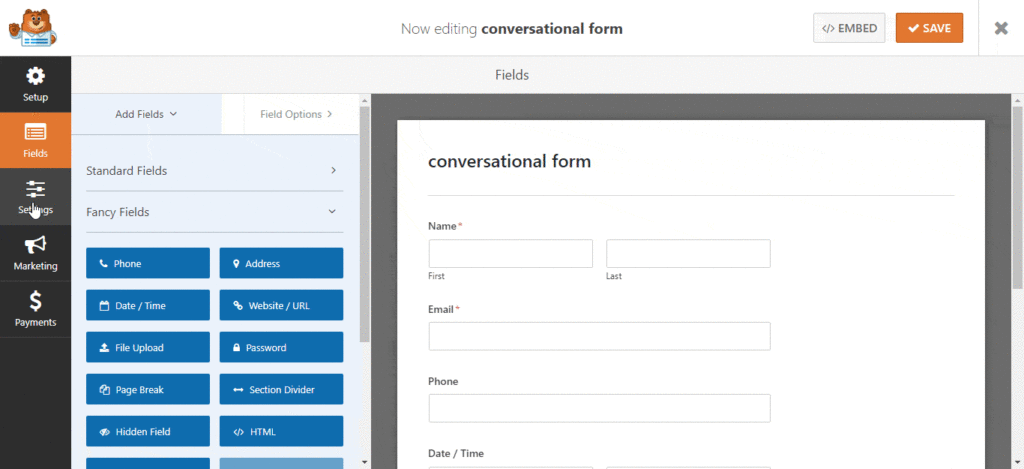
Go to “Settings” from the left-side menu to start configuring the form, then click General.
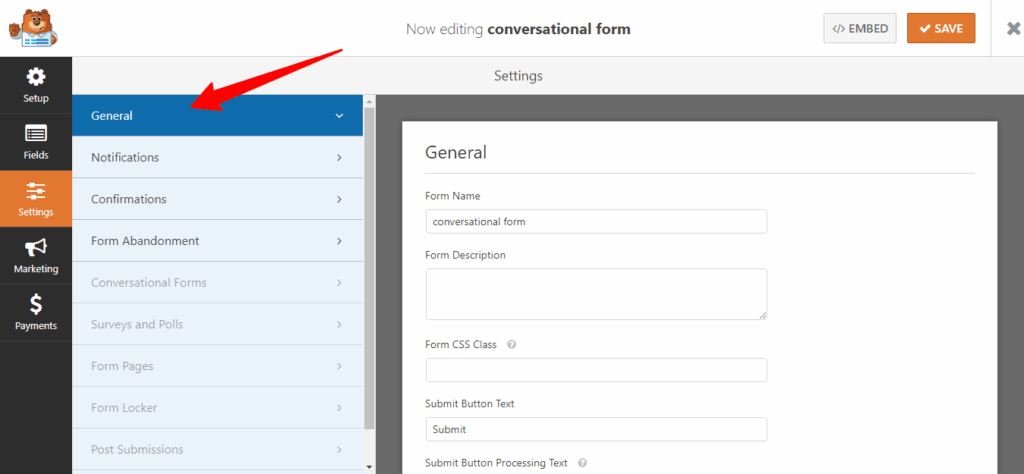
On this page, you can configure the following:
Remember to click Save once you’re done with the form configuration settings. And move to the next step, which is…
Step 4. Conversational Form Enabled
We need to turn your simple contact WPForm into conversational web forms.
This is where the WPForms conversational add-on you installed earlier becomes useful. Click “Conversational Forms” on the left-side panel on the settings page.
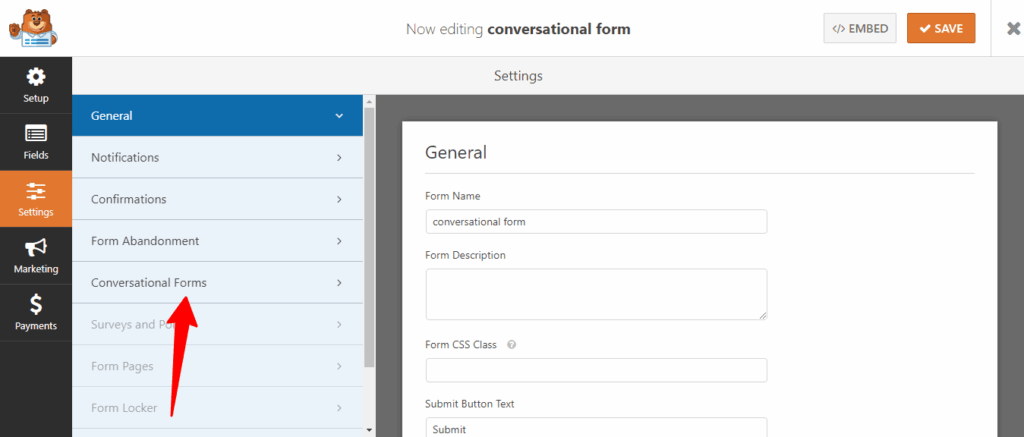
Note: This field will turn grey if you don’t install the conversational add-on. In this case, activate the add-on from the WPForms main menus.
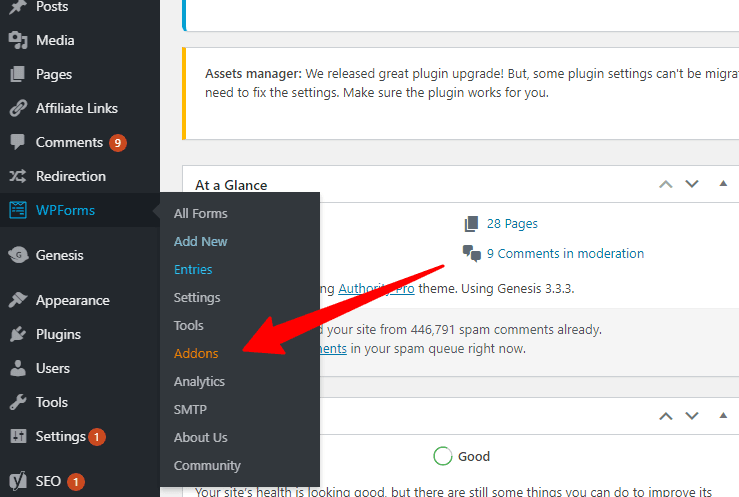
After activation, refresh the settings page for this addon to work.
A small dialog box will open when you click on confirmation on the left-hand side.
Check the “Enable conversational Form mode” box to reveal the content editor.
Here you can:
When you’re done selecting, click the save button at the top of the page.
That’s it!
Your WPForms conversational forms are ready to use on your website. The next step is…
Step 5. Adding Your Conversational Form to Your Pages/Post
Now that your form is ready, you may want to add it to your WordPress pages/posts or widgets.
With WPForms, you can add your contact forms anywhere on your blog, such as the sidebar, inside content, or the footer.
To add your conversational form to your blog, create a new WordPress page or post or edit an existing one.
Click the + icon in your WordPress editor to reveal the block editor’s selection panel. Then, type “WPForms” in the search bar and click on it.
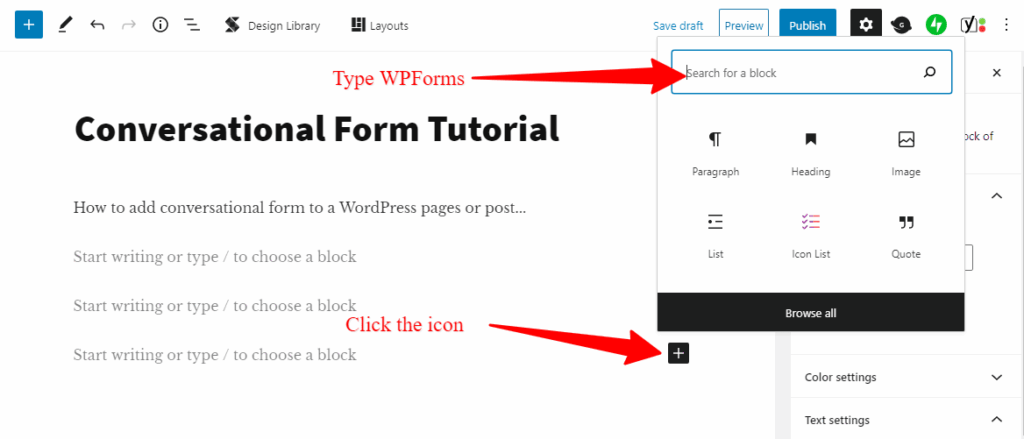
In the WPForms dialog box, select your conversational form from the drop-down menu.
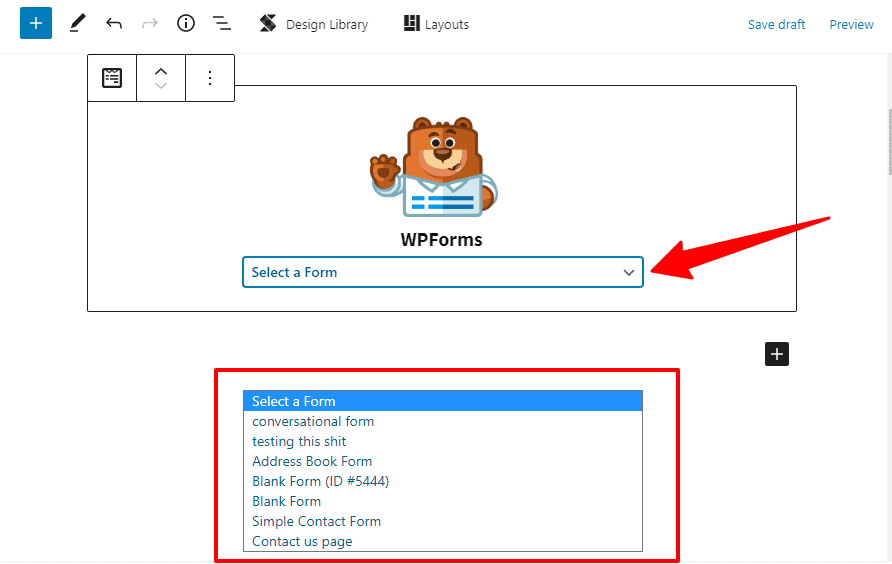
Your conversational form is now live on your blog. The next thing is to hit the publish button. And your form is ready for user interaction.
Step 6. Setting up Form Submission Notification
As a business owner, you must follow up with your contact form users. WPForms makes getting form notifications easy to set up.
You probably want to get notified immediately when you receive an email entry from your conversational form. This helps you know if it’s urgent so you can act accordingly.
How do you set up email notifications with WPForms?
To set up an email notification alert, click “Setting” in the WPForms admin panel. Then click on “Notification” on the left side of the panel.
On the right, edit the email, the message, the recipient and the reply-to field. There are other email features you might want to edit on this page:
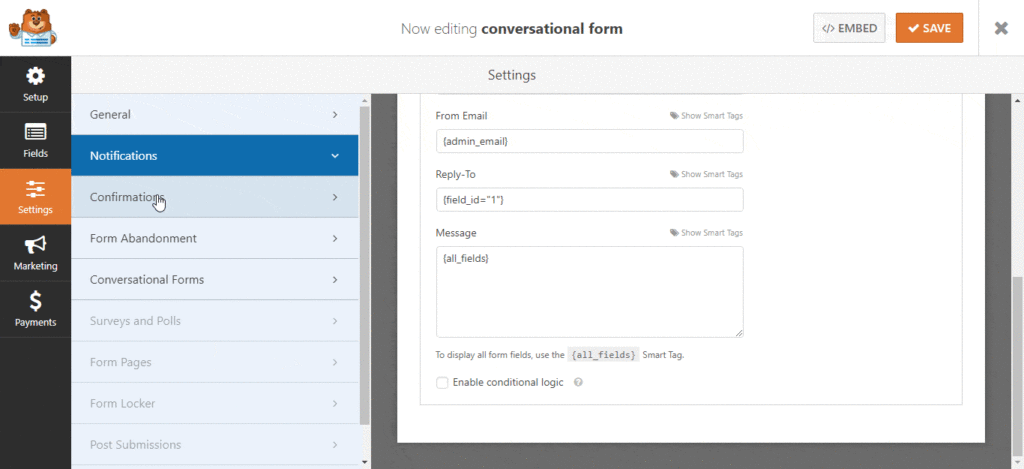
You can edit any of these form fields to suit your brand message.
If you use smart tags, users will also get an email notification acknowledgment to confirm the success of their message.
You can also enable conditional logic for email notifications.
This helps filter emails, so you only get notifications for what’s most important to you.
Step 7. Enabling Form Confirmation Message
When users submit a form through the conversational contact form on your website, you may want to show them personalized messages.
This lets users know their message has been received. It also allows you to direct your contact form users to a web page.
WPForms offers 3 confirmation options.
- Message – By default, when users submit an email through the WPForms contact form, a simple message is displayed to let them know their message has gone through. You can customize the content of this message in the WPForms content editor.
- Show Page – This option lets you direct users to a specific page on your website after submitting a form through your conversational contact form.
- Go to URL (Redirect) – With this option, you can redirect your contact form users to external websites after form submission.
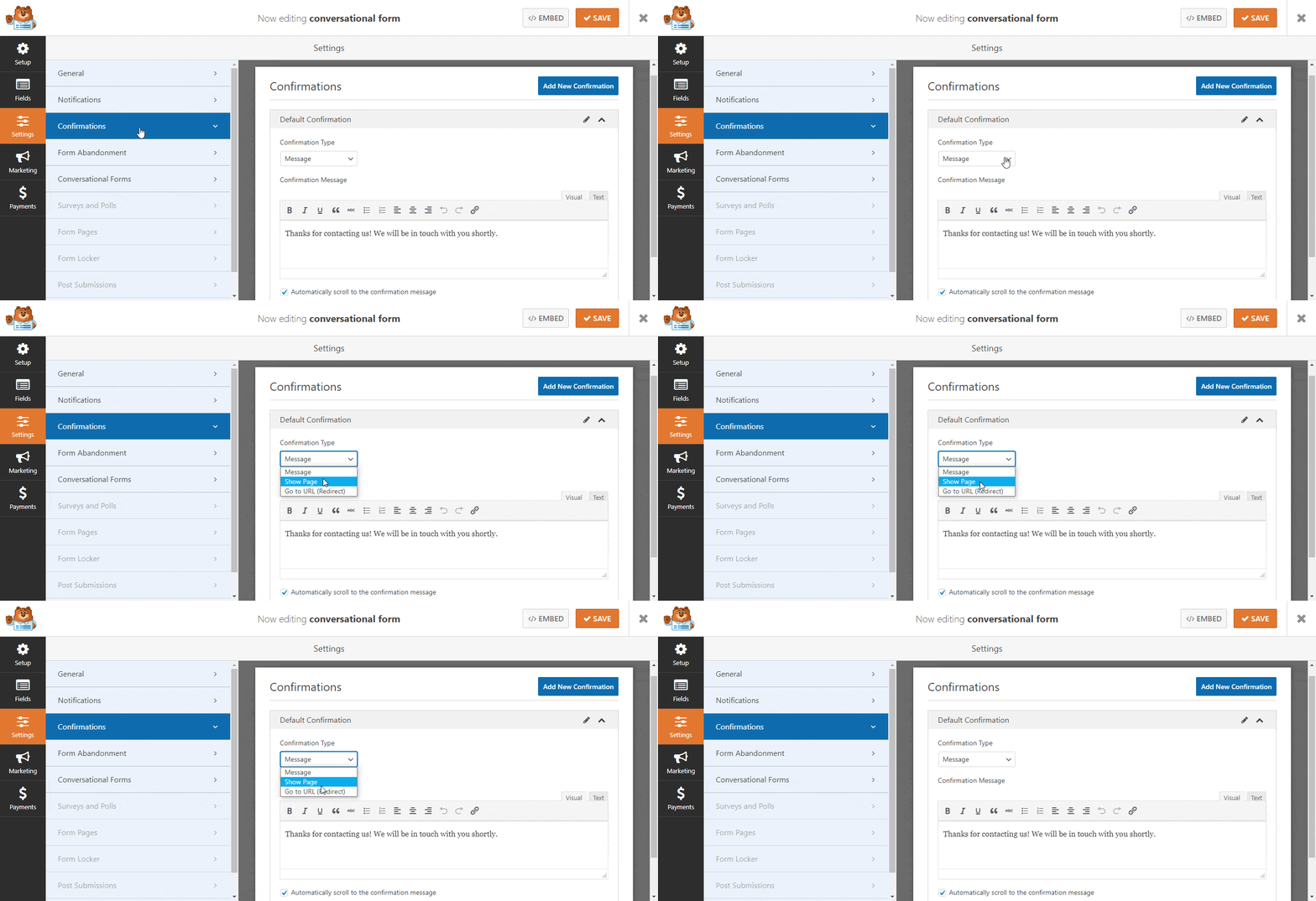
Click on the setting in the WPForms editor to set up your confirmation message. Next, click on the confirmation.
Now, select your confirmation type.
Depending on your selected option, you can customize the content of the “message” confirmation. The two other options allow you to select your preferred website page URL.
FAQ – WPForms Conversational Forms
What is a conversational form?
Conversational forms are interactive web forms that provide a better user experience as users complete them. They are engaging, offering an interactive, conversational approach to collecting user data on the landing page or form. Instead of overwhelming users with all the fields at once, a conversational form breaks the process into multiple pages, making it easier to complete.
Are conversational forms better?
Conversational forms are better because they make filling out forms less intimidating and challenging for users. They make it feel like a discussion or like responding to questions from an interviewer.
How to Design a Conversational Form?
The best way to design your conversational form in WordPress is to use a plugin like WPForms or Gravity Forms. This plugin makes it easier to add fields and features to your form. They use drag-and-drop editors, form templates, and add-ons, making the style and design of your smart forms painless.
Conclusion…
Setting up a conversational WordPress form isn’t difficult.
With the right tools, anyone with no coding skills can complete the entire process with the WPForms WordPress plugin.
Now that you’ve got the WPForms conversational form tutorial, it is time to grab the WPForms Pro account to get started with your contact forms.




Hey SHAMSUDEEN ,
Awesome post with fantastic work. You have provided effective & helpful tips to create Conversational contact forms in Wpforms.
Yes i completely agree with your words that conversational forms make the content on the page more attractive and also helps in generating more leads. Conversational web forms are really easy to setup, boost the signup rate and also makes it possible for the user to ask queries, questions and doing interaction and conversation as well.
Your each steps ( including images ) to create conversational contact forms in wpforms are so clear, easy to understand and are also providing good & better understanding. Following the steps will be a great helping hand.
After going through this complete guide i really got helpful ideas and have also boosted my knowledge upto some limit.
Eventually thanks for sharing your ideas, knowledge and such a helpful post.
Hi Aadarsh,
Good to see you around once again…and thanks for the usual valuable comments. I valued your time here and appreciate your inputs. Thanks.
Thank you so much for this blog. I really like this.
Thanks Dan,
Glad you like the blog.
Awesome Article. About WP Forms you’re providing such a useful information. Thank you so much for sharing this Article
Glad to see you find it useful, thanks.
Great Post! Your article is really helpful. I am glad to read this awesome post. Thanks for sharing such a helpful post. Keep Posting!!
Thanks Aisha,
Glad you like it.