
If you have looked into print on demand, you have probably typed “Printify pricing” into Google more than once, trying to figure out what you will actually pay before you commit. The short answer is that Printify itself is free to join and free to use.
The part that trips people up is that “free” does not mean “no costs at all.” You still pay a production cost every time a customer orders, and you can optionally pay a monthly subscription for bigger discounts.
This guide breaks down exactly how Printify pricing works in 2026, what each plan includes, how much you actually pay per product, and whether upgrading to Premium is worth it for your store.
Does Printify Cost Money to Sell?
Technically, no. There is no fee to create an account, connect a store, or upload unlimited designs. Printify does not charge listing fees, platform fees, or monthly minimums on its Free plan.
Where the money changes hands is at the production stage. Every time someone buys a t-shirt, mug, or hoodie from your store, Printify charges you the base fulfillment cost for making and shipping that item.
You set your own retail price, and the difference between what you charge and what Printify charges you is your profit. Printify does not take a commission on your sales.
It earns money from the margin built into its production pricing, which is exactly how it can afford to let merchants join and sell for free.
So if you are wondering how much Printify charges for selling, the honest answer is that it depends entirely on the product, the print provider you choose, and how you price it. Printify is not taking a cut of your revenue; it is charging you for the physical item.
NOTE:
If you’re new to print on demand or trying to figure out if Printify is the right fit, check out our review of Printify for a thorough breakdown of the platform based on firsthand experience.
Printify Pricing Plans Explained
Printify runs three subscription tiers: Free, Premium, and Enterprise. Only Premium and Enterprise carry a monthly cost. Here is how they compare.
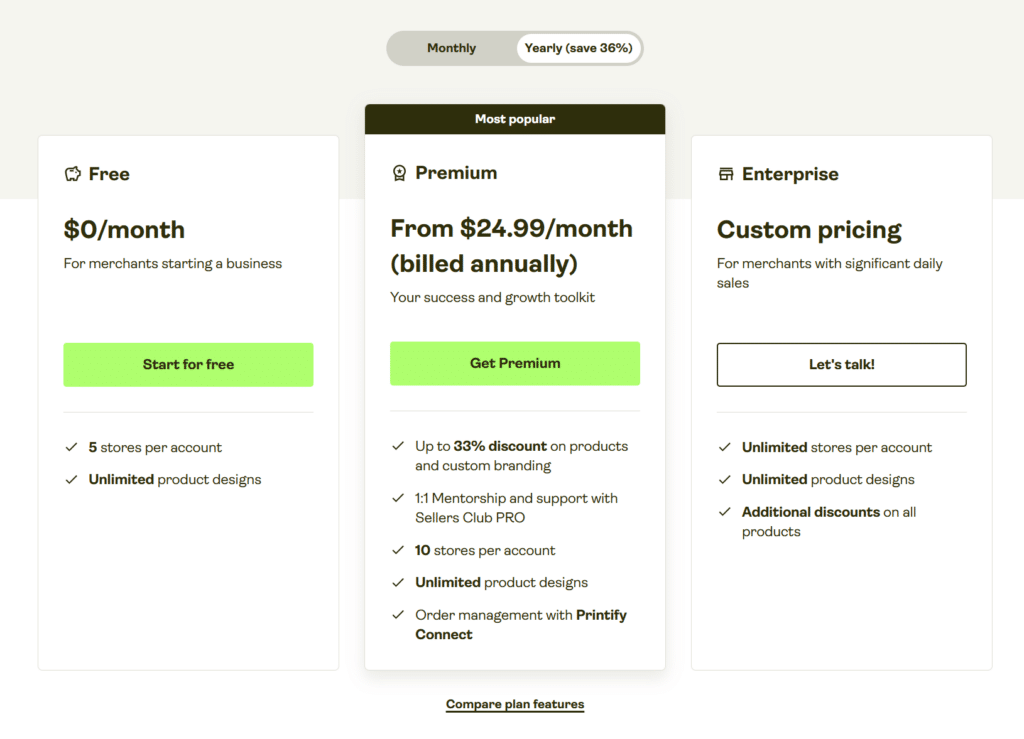
Free Plan ($0/month)
The Free plan is genuinely usable for a real business, not just a demo. It includes:
For anyone starting out or testing a niche, the Free plan is where most sellers begin, and they stay on it long-term since it never expires or requires a credit card.
Premium Plan (From $39/month, or $24.99/month billed yearly)
This is where the Printify Premium cost comes into play, and it is the plan most established sellers eventually consider. Paying monthly runs $39, while committing to an annual plan drops the effective price to $24.99 a month, a savings of roughly 36%.
Premium adds:
The math on Premium usually comes down to volume. If your product discounts save you more per month than the $39 or $24.99 subscription costs, upgrading pays for itself. For a store doing consistent daily sales, that threshold is often reached quickly.
Enterprise Plan (Custom Pricing)
Enterprise is built for merchants doing significant daily volume who need more than the standard toolkit. Instead of a listed monthly fee, pricing is negotiated directly with Printify’s sales team. It includes:
If you are running a high-volume operation and need custom workflows or white-label support, this is the tier to talk to Printify’s sales team about rather than trying to estimate a price on your own.
Printify Plan Comparison at a Glance
| Feature | Free | Premium | Enterprise |
|---|---|---|---|
| Monthly price | $0 | From $39 (or $24.99 billed yearly) | Custom |
| Stores per account | 5 | 10 | Unlimited |
| Product designs | Unlimited | Unlimited | Unlimited |
| Product creator | Yes | Yes | Yes |
| Sales channel integrations | Yes | Yes | Yes |
| Discount on products | None | Up to 20-33% | Additional discounts |
| AI Mockups | No | Yes | Yes |
| Printify Connect | No | Yes | Yes |
| Sellers Club PRO mentorship | No | Yes | Yes |
| Custom API integration | No | No | Yes |
| Dedicated account manager | No | No | Yes |
How Much Does Printify Charge Per Shirt?
This is one of the most searched Printify pricing questions, and the honest answer is that there is no fixed number, because it depends on the print provider, the shirt style, and the printing method.
That said, Printify’s own profit calculator gives a useful reference point. A standard unisex jersey short-sleeve tee carries a fulfillment cost of roughly $8.77. If you sell that same shirt for $19.99, you are looking at a profit of over $11 per sale before shipping and any storefront fees.
Other product categories follow the same logic, just at different price points. A heavy blend hooded sweatshirt runs closer to $15.89 in fulfillment cost, sublimation socks around $5.29, and phone cases around $10.73.
These numbers shift depending on which print provider you select for that product, since Printify works with 90+ print providers across 140+ fulfillment centers, and costs vary by provider location and materials.
Using the Printify Pricing Calculator
Printify’s pricing page includes a built-in profit calculator that lets you plug in a retail price and expected daily sales to see projected monthly earnings for specific products like tees, hoodies, socks, phone cases, and canvas prints.
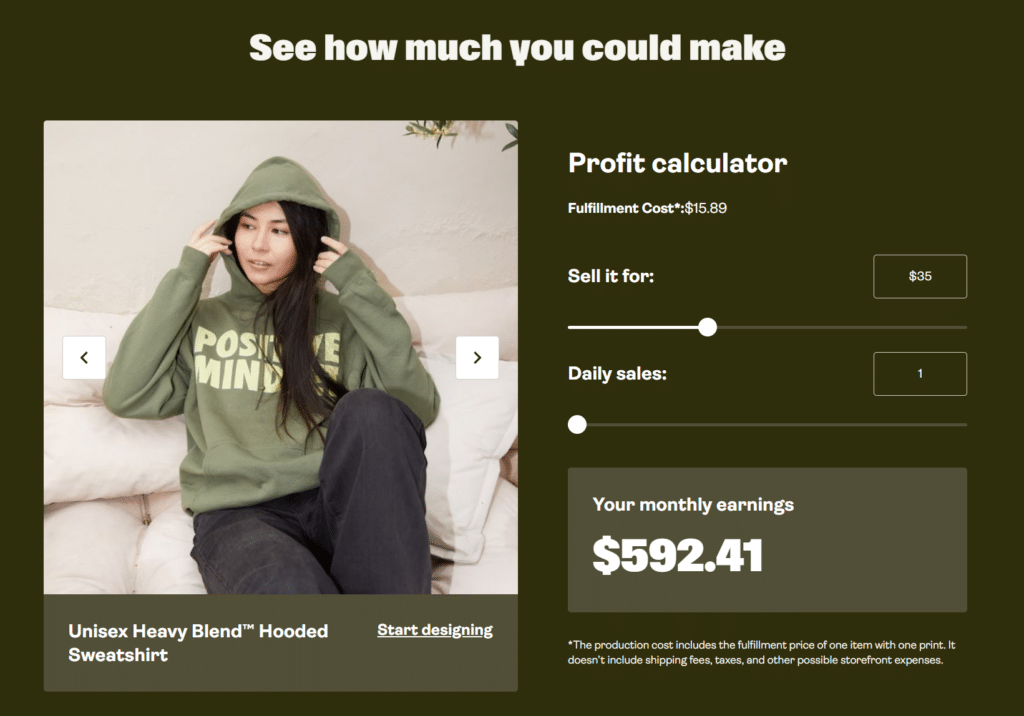
It is a genuinely useful tool before you commit to a price point, since it strips out guesswork and shows you the fulfillment cost side by side with your proposed retail price.
Keep in mind that the calculator only accounts for the fulfillment price of one item with one print location. It does not factor in shipping charges, taxes, transaction fees from your sales channel, or any other storefront costs, so treat the output as a starting estimate rather than your final margin.
Printify Shipping Costs
Shipping is billed separately from the production cost and is not included in the base fulfillment price shown on product pages or in the calculator.
Shipping rates vary by print provider, destination, product weight, and whether the customer is in the same country as the fulfillment center or ordering internationally.
Because shipping is provider-specific, the most reliable way to see exact numbers for your products is to check the shipping rates listed for each item inside the Printify product catalog. Since a provider based near your customer will usually cost less to ship from than one on the other side of the world.
How Much Does Printify Charge for Production and Shipping Combined?
When people ask this, they are usually trying to estimate their true landed cost per order. The formula is simple in concept: production cost plus shipping cost equals your total fulfillment cost.
Subtract that from your retail price, and whatever is left is your profit before any platform fees your sales channel charges (Etsy and Shopify, for example, each have their own separate transaction and listing fees).
There is no single number that applies across the board, since a t-shirt shipped domestically will cost noticeably less than the same shirt shipped internationally, or printed by a different provider.
Running your specific products through the profit calculator with realistic shipping estimates added on top is the most accurate way to budget.
Is There a Cheaper Option Than Printify?
Printify sits in a competitive field alongside platforms like Printful, Gelato, and SPOD, and pricing comparisons genuinely depend on the specific product and print provider involved.
Printify’s advantage is choice. Because it works with 90+ print providers, you can often shop around within the platform itself for a lower base cost on the same product, something single-provider platforms cannot offer.
Whether a competitor works out cheaper for your specific catalog is worth checking product by product rather than assuming one platform is universally less expensive.
Does Printify Pay Real Money?
Printify does not pay you directly. It is not an ad network or a rewards program.
What happens is that you set your own retail prices, sell through your own store or connected sales channel, collect payment from your customers there, and then pay Printify the production cost when the order is fulfilled.
The difference is real money that lands in your account, but it comes from your customers, not from Printify itself.
Which Printify Plan Should You Choose?
FAQs
Final Thoughts
Printify pricing is more straightforward than it first appears once you separate the free platform from the paid production costs.
Joining, designing, and listing products will not cost you anything. What you pay for is the physical product itself, and whether a Premium subscription makes sense comes down to whether your sales volume is high enough for the discounts to outweigh the monthly fee.
For most people starting out, the Free plan is more than enough to launch and start testing what sells.