
Approximately 26 million eCommerce stores are online globally.
If you think the global eCommerce industry needs to be more competitive, consider that worldwide retail market revenue is estimated to reach $3.64 trillion in the coming year.
Small business owners can find competing in the e-commerce industry challenging. They must have the tools and resources to outrank their competitors.
Most importantly, you need the best eCommerce SEO tools to improve website performance, diagnose SEO bottlenecks, track keyword rankings, and enhance overall search engine visibility.
In today’s article, I review several free and paid SEO tools for eCommerce sites of all sizes.
Whether you’re a small online store owner, a mid-size business, or a large-scale enterprise, this list is a helpful SEO tool for all online e-commerce shop owners.
Without further introduction, let’s dive in.
What Are eCommerce SEO Tools?
eCommerce SEO tools are software solutions designed to improve online stores’ visibility in search engine results.
These tools provide valuable insights and capabilities to optimize various aspects of an eCommerce website, including product and category pages and overall site structure, to improve rankings and drive organic traffic.
Key Features of eCommerce SEO Tools
These tools help online retailers drive more organic traffic, improve user experience, and ultimately increase sales by attracting the right audience to their eCommerce stores.
Benefits of Using SEO Tools for eCommerce
Using SEO tools for an eCommerce business has many advantages for small business owners. You can drive more traffic, improve your website’s performance, and increase sales.
Here are the key advantages you should consider when using search engine optimization tools for growing your eCommerce site:
1. SEO Powersuite
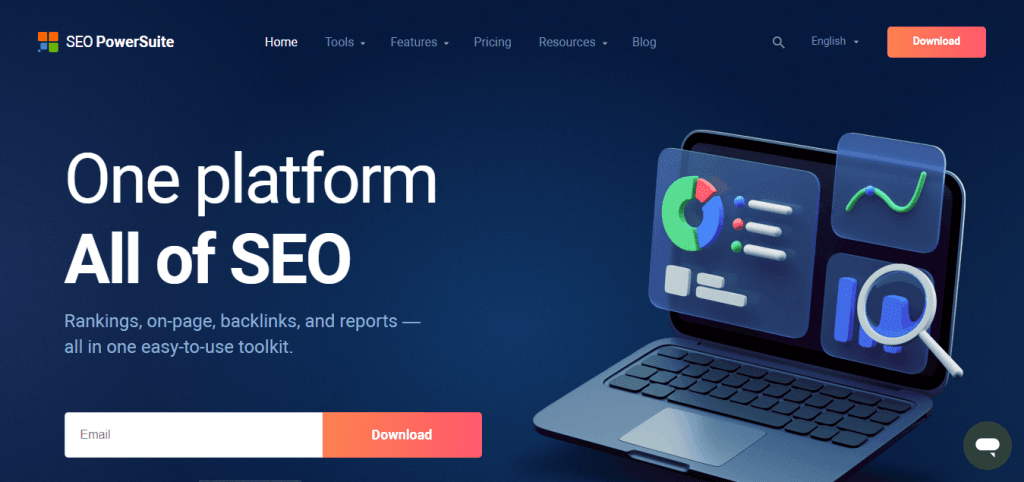
If you’re looking for affordable search optimization software for your eCommerce store, SEO Powersuite is a top choice.
The SEO Powersuite bundle kit covers most aspects of an SEO strategy. From site audit to competitor research, off-page SEO to comprehensive keyword research, and position tracking, it has every tool you need to succeed in digital marketing.
SEO Powersuite is more cost-effective than other eCommerce site optimization software. It’s cheaper yet provides in-depth analysis reports on par with most top SEO tools.
The free version offers limited access and features and is suitable for beginner eCommerce store owners.
You can download it from the button below and consider upgrading if your SEO strategy requires access to advanced features, customization, and control.
Moreover, SEO Powersuite is a desktop application comprising four independent SEO toolkits: Rank Tracker, SEO Spyglass, Website Auditor, and Link-Assistant.
Read my SEO Powersuite reviews to learn more about its powerful features and functionalities.
SEO PowerSuite Top Features
2. NitroPack
According to a recent report by Tool Tester, the conversion rate decreases by 0.30% for each additional second it takes for an e-commerce page to load.
Furthermore, a Shopify blog post states that reports show you can potentially lose an average of $9k daily if your site speed is too low for users.

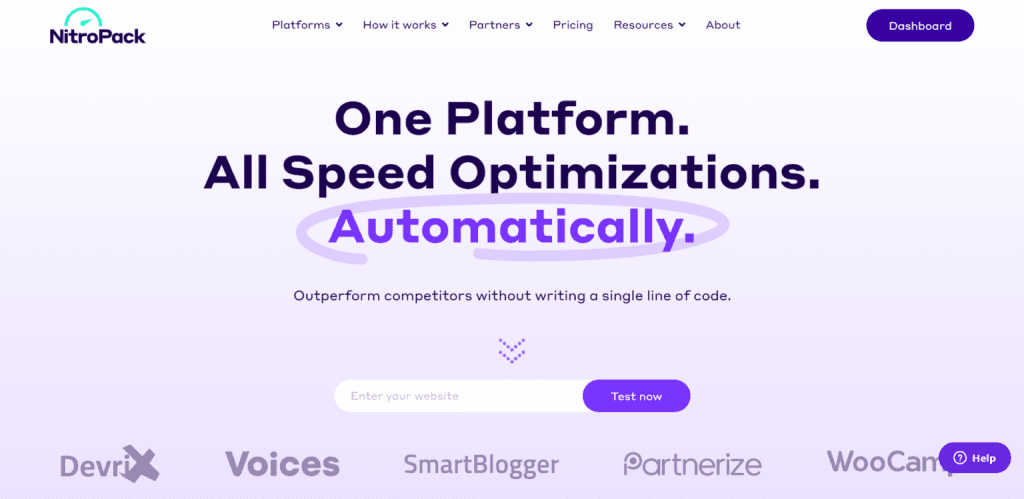
NitroPack is a cross-platform site speed and performance solution that lets you optimize individual pages and entire websites for maximum page speed.
It is an all-in-one solution that serves as a site cache, image and HTML/CSS/JS resource optimizer, and more.
It’s the perfect solution to optimize Google Core Web Vitals, improve site performance, remove unused CSS, preload the largest Contentful Paint, and eliminate render-blocking resources.
NitroPack offers several speed-optimization features that help eCommerce sites benefit significantly from its tools and improve the user experience, especially on checkout pages.
If you use Magento, OpenCart, WooCommerce, or WordPress as your e-commerce platform to sell online, NitroPack can help you increase your eCommerce store speed with less effort.
NitroPack Top Features.
3. Surfer SEO
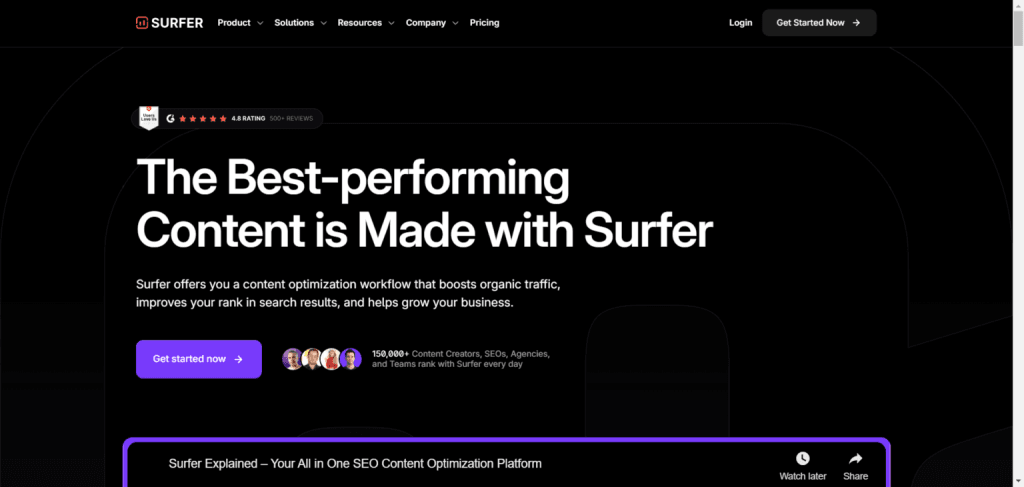
Surfer SEO is a comprehensive, data-driven tool that simplifies content optimization. It helps you create and improve content by analyzing over 500 search ranking factors and comparing your work against top-ranking pages in Google search results.
Whether you’re working on a new article or revamping old content, Surfer SEO provides actionable insights to boost your search engine rankings.
One standout feature is its seamless integration with Google Docs and WordPress sites. This allows you to optimize content directly within the platforms you use most, making the process efficient and hassle-free.
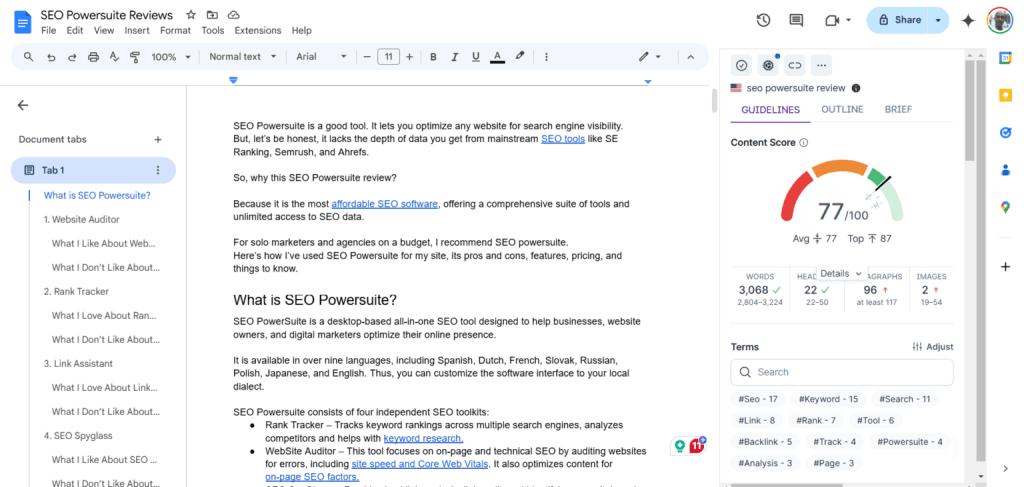
Surfer’s Content Editor provides real-time suggestions on keywords, headings, NLP terms, images, and word count based on your target keyword and competitors’ data.
The Audit Tool helps refine existing content by identifying gaps such as missing backlinks, underutilized keywords, missing meta tags, or slow page speed.
With the SERP Analyzer, you can dive deep into competitor analysis, understand what’s working for them, and apply similar strategies to your content.
The Keyword research tool helps you uncover valuable search terms to target, while Topical Maps ensures your content ideas cover all relevant angles for a given topic.
Ask Surfy is an AI writing assistant that offers AI-driven responses to common SEO questions. You can prompt it to write an article, expand sentences, or do anything else, just like you would ChatGPT or any other AI writing tool.
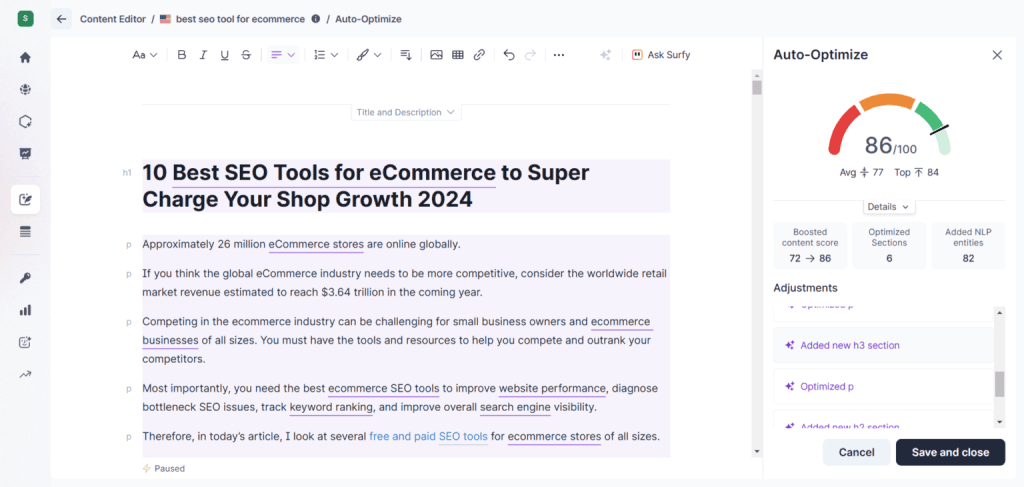
The new Auto-Optimize tool takes on-page optimization a step further by automatically applying recommended changes, saving you time for the content creation.
Whether you’re a beginner or an experienced SEO, Surfer SEO provides the tools to improve content performance and stay ahead of the competition.
Top Features of Surfer SEO
Surfer SEO offers a range of powerful tools to simplify and enhance your article optimization process. Here’s a breakdown of its key features:
With these features, Surfer SEO equips you with everything needed to build, optimize, and maintain content that stands out in search results.
4. ConvertMate
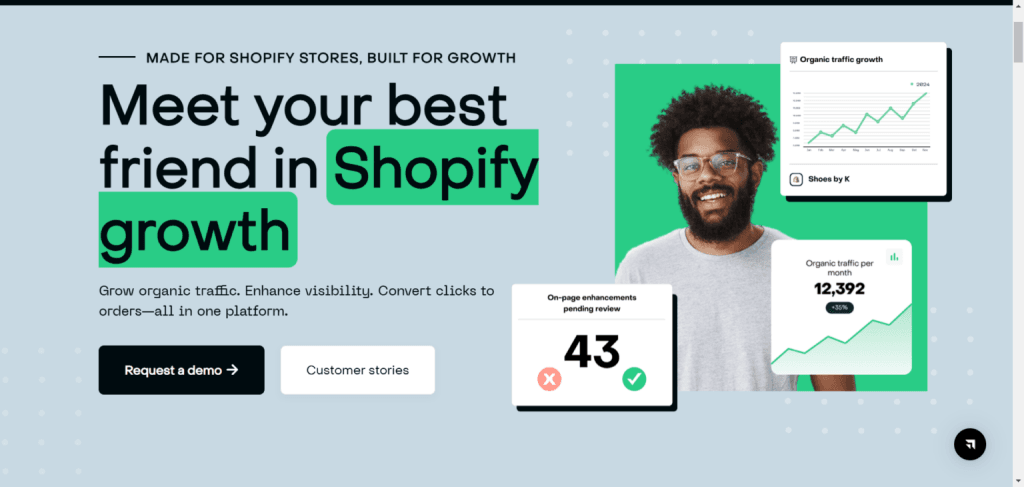
ConvertMate is a powerful SEO tool tailored for Shopify stores. It simplifies SEO workflows with features like audits, keyword research, on-page optimization, and automated content creation.
With real-time SEO insights and automation, this Semrush alternative helps e-commerce owners boost organic traffic effortlessly and stay ahead in search rankings.
ConvertMate Top Features
5. Pro Rank Tracker
Accurately tracking keyword positions is critical to making content and marketing optimization decisions.
Pro Rank Tracker is the number one keyword position tracking tool your e-commerce store can rely on.
It lets you track keyword positions in 187 Google sites, including Google Business Profile, local maps, YouTube, SERP, 35 Yahoo sites, 32 Bing sites, and all Amazon listing sites.
Also, you can track mobile and desktop keyword ranking positions separately, get the search volume in different marketing platforms, discover unknown ranking search phrases, and get accurate competition for a keyword in the SERP top 100.
Pro Rank Tracker’s Top Features
6. Ahrefs

Ahrefs is a popular SEO tool for eCommerce site optimization and digital marketing professionals.
While not as cost-effective as other SEO software on this list, Ahrefs is a comprehensive SEO tool that covers every aspect of digital marketing optimization.
From a deep crawl-site audit to a powerful keyword research tool, an advanced competitor analysis tool, and a backlink checker, Ahrefs is on another level.
Thanks to its free webmaster tool, beginner eCommerce entrepreneurs can now use Ahrefs’ free tools to audit their online stores, discover on-page SEO issues, do keyword research, and check competitors’ traffic stats.
If you can afford the monthly subscription fee, Ahrefs is one of the best SEO tools.
It is not a magic bullet, but it provides access to many SEO and marketing tools and data you won’t find in other SEO performance optimization software.
Ahrefs Top Features
7. SE Ranking

SE Ranking is the right platform to simplify SEO, improve online store ranking, automate complex SEO tasks, and increase brand visibility.
One of SE Ranking’s core strengths is its keyword research tool, which helps you identify relevant keywords based on geolocation. This is a powerful local SEO tool for webshops.
Another essential feature of its solution is its backlink checker tool. It allows you to analyze competitors’ backlink profiles, discover lost and new links, find link-building opportunities, and more.
Moreover, you can analyze referring domains (where competitors get links from), check anchor text and linking pages, measure link value, and spy on other brands’ link-building tactics.
Competitor research is a powerful tactic for e-commerce businesses; SE Ranking provides tools to gain in-depth insights into competitors’ overall marketing strategies.
SE Ranking is an all-in-one SEO platform that covers everything from PPC competitors to organic search engine traffic, paid advertising, total traffic cost, keyword analysis, and more.
SE Ranking Top Features
8. Google Search Console
Google Search Console, or GSC, is a MUST-HAVE technical SEO tool for eCommerce business owners.
If you want to improve your online store’s Google search engine ranking potential, this is one of the e-commerce SEO tools you must consider. GSC lets you perform several SEO tasks.
First, GSC is where Google communicates technical issues affecting your website with you.
Google lets you know through GCS how many indexed pages you have in its algorithm, how many non-indexed pages you have, and why they have not been indexed.
You also get detail report on issues with Core Web Vitals and access to link profiles, sitemaps, URL inspection tools, mobile usability issues, HTTPS pages, etc.
In addition, GSC lets you analyze your website’s Google organic traffic data and filter results by keyword ranking position, click-through rate, ranking pages, devices, countries, dates, Google search result type, and more.
If your website receives a manual penalty or there are potential security issues for users, Google communicates this through GSC.
GSC Top Features
9. Google Analytics
Unless you’ve built a custom analytics tool, Google Analytics is the most powerful free website analytics software.
Whether you’re running an eCommerce website, personal blog, business, or nonprofit organization, as long as you track traffic on your site, Google Analytics is a must-have tool.
However, since Google upgraded Analytics from Universal Analytics to GA4, many website owners have reported that GA4 is less beginner-friendly than Universal Analytics.
GA4 provides website owners with more data and lets them track and customize it to what really matters to their business.
GA4 is free; like most Google products, it only requires a Gmail account. If you’re a WordPress user with the Astra theme, learn how to add GA4 and other third-party scripts to your theme.
GA4 Top Features
10. Helium10
Helium10 is an essential eCommerce SEO tool primarily built for Amazon and Walmart merchants.
It has tools that streamline many aspects of your Amazon FBA eCommerce business.
Helium 10 provides tools for everything from product research and keyword identification to listing optimization, store analytics, and advertising.
The Chrome extension lets you find and analyze products in high-demand niches from your browser. You can filter product research by various metrics – reviews, weight, competition, season, etc. – allowing you to weed through the chaff quickly.
In summary, Helium10 has 30+ eCommerce SEO and marketing tools, enabling merchants to transform their Amazon business to the next level.
Helium 10 Top Features
11. Semrush
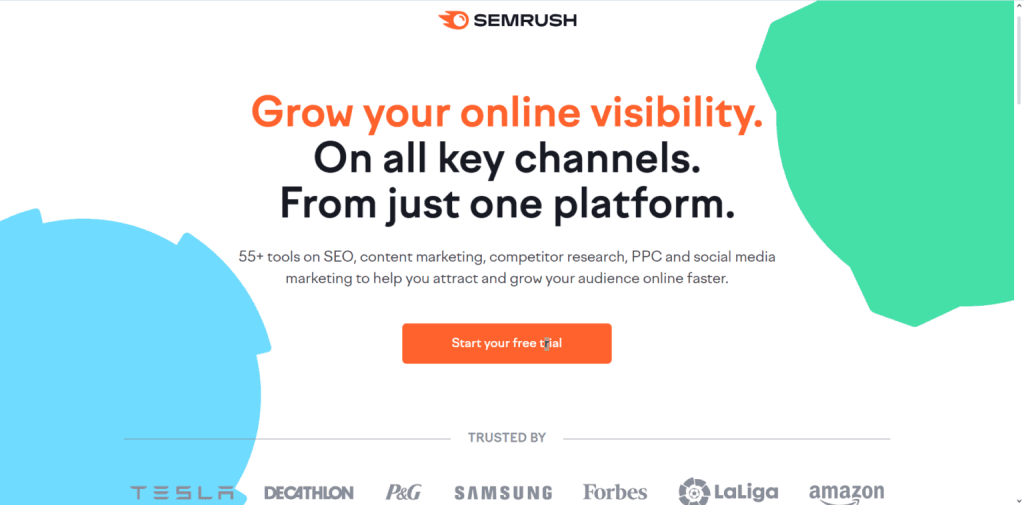
Semrush is one of the most comprehensive SEO tools for e-commerce optimization. It is used by over 10 million small brands, SEO professionals, and large-scale businesses.
Though Semrush is expensive, it offers immense value and tools for everyday SEO tasks.
Semrush’s comprehensive suite of tools now includes over 60. From competitors’ analysis tools to in-depth site audits, marketing research, advertising, social media marketing, and agency solutions, Semrush covers it.
Semrush lets you research profitable long-tail keywords, discover competitor advertising and organic strategies, analyze search engine results pages, evaluate and compare store pages, perform keyword research, run site audits, etc.
Also, you can run in-depth on-page and off-page SEO analysis to improve your online store’s search engine visibility, making it a complete SEO tool for eCommerce shop owners.
Semrush Top Features
FAQs
Why do I need SEO software for my eCommerce store?
SEO tools can help you identify the right keywords, analyze competitors, improve site performance, and create optimized content, all of which can lead to higher search rankings and increased sales.
What are some must-have features in eCommerce SEO tools?
Key features include keyword research, site audits, backlink analysis, rank tracking, competitor analysis, and on-page optimization.
Which SEO tools are best for small eCommerce businesses?
Affordable tools such as SE Ranking, SEO Powersuite, and Ubersuggest are great options for small eCommerce businesses seeking value without sacrificing functionality.
Can eCommerce SEO Software help with product descriptions?
Tools like Surfer SEO and Clearscope can help you optimize product meta descriptions with the right keywords and formatting for better rankings. These tools also generate meta tags, such as image ALT attributes and SEO title tags.
Are there free SEO tools available for eCommerce sites?
Yes, free tools like Google Keyword Planner, Google Analytics, and Ubersuggest can provide essential SEO insights for eCommerce websites. These tools are free, except for Ubersuggest, which offers paid plans.
Can SEO tools integrate with my eCommerce platform?
Yes, many tools offer integrations with popular platforms such as Shopify, WooCommerce, and Magento, making it easier to manage SEO directly within your online store.
Conclusion
There are plenty of marketing and SEO tools for e-commerce business owners to explore and use to grow their businesses.
These ten listed here scratch the surface, which brings us to the question: Which SEO e-commerce software are you using?
You could mention one or two from the list above or tell us your favorite e-commerce tools in the comments section.
Still, I hope this list helps you discover a new tool to try in your business operations and make the job easier.